Surf Etiquette: The Unwritten Lineup Rules

Neptune
March 9, 2026
Why Surf Etiquette Exists
There are no referees in the water. The lineup still runs on rules.
They exist for safety and fairness — priority at a shared peak, and fewer collisions.
The problem is that nobody hands you a rulebook when you start surfing. Most beginners learn etiquette the hard way — by getting yelled at, unknowingly ruining someone's wave, or creating a dangerous situation without realizing it. This guide covers everything you need to know so that doesn't happen to you.
Rule 1: The Surfer Closest to the Peak Has Priority
This is the foundational rule of surfing. The surfer closest to the peak — the steepest, most critical part of the breaking wave — has the right of way. Everyone else must yield.
Why? Because the surfer closest to the peak is in the best position to ride the wave. They'll be first to their feet, first to generate speed, and committed to the wave before anyone further down the shoulder. If you're still learning to identify the peak, our guide on how to read waves and pick the right one covers the fundamentals.
How This Works in Practice
Imagine a wave breaking from right to left. Three surfers are paddling for it. Surfer A is deepest — closest to where the wave is breaking. Surfer B is ten feet to A's right (further down the shoulder). Surfer C is even further out on the shoulder.
Surfer A has priority. If A catches the wave, B and C must pull back. If A doesn't go, B has priority over C.
What If Two People Are Equal?
Sometimes two surfers are equidistant from the peak. In casual sessions, this usually resolves with a quick look and a call — one surfer says "go!" or "you got it!" and backs off. In competitive lineups, the surfer who's been waiting longest or paddles most aggressively typically takes it. Communication is key. Make eye contact, call the wave, and be willing to share.
Rule 2: Don't Drop In
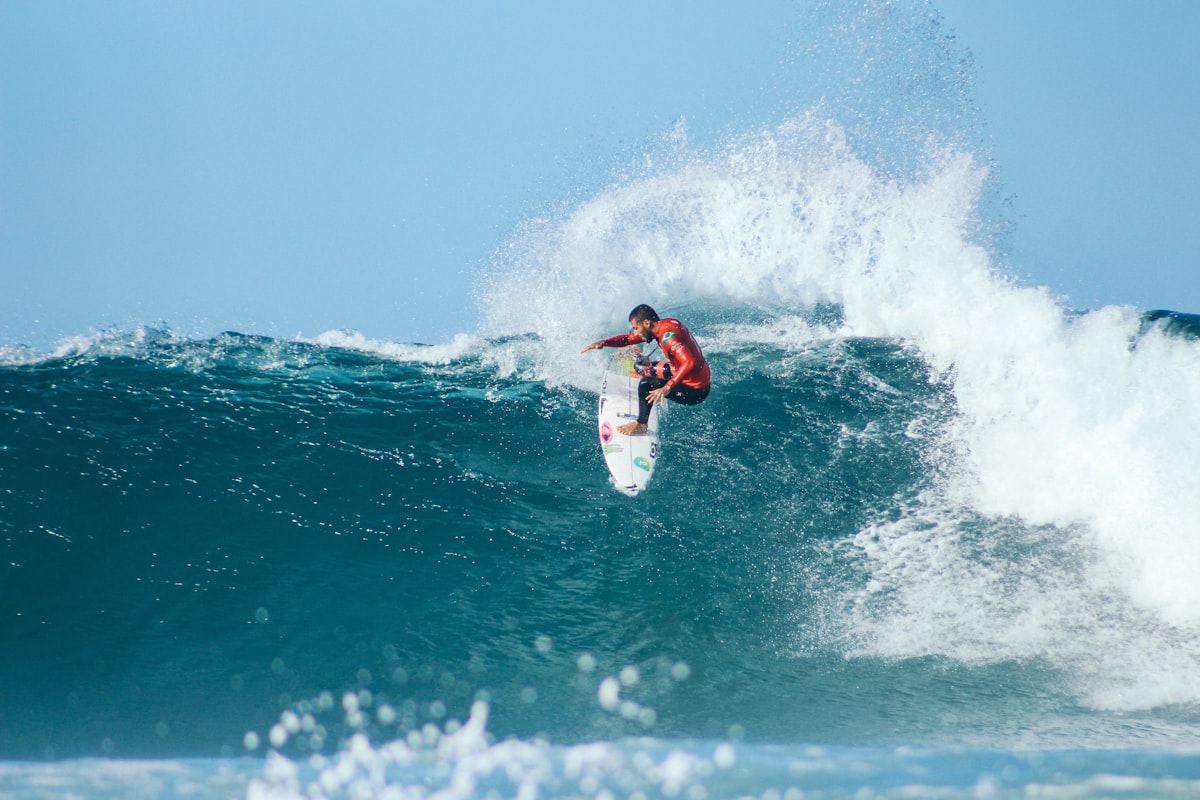
"Dropping in" means catching a wave in front of someone who already has priority. It's the single most common etiquette violation in surfing, and the one most likely to get you yelled at — or injured.
Here's what it looks like: a surfer is already riding a wave, cruising down the line. You paddle into the wave further down the shoulder, pop up, and start riding in front of them. You've just dropped in. You've stolen their wave, blocked their line, and created a collision risk.
Why Dropping In Is Dangerous
When you drop in, the surfer behind you has nowhere to go. They're already committed to the wave, carrying speed, and potentially setting up a turn. If they hit you — and at speed, on a hard fiberglass board — someone's getting hurt. Fin cuts, board impacts, and head injuries all happen because of drop-ins.
How to Avoid Dropping In
Before you take off on a wave, look both ways. Glance toward the peak to see if someone is already up and riding. If someone is, pull back. This takes one second and becomes automatic with practice. The look is everything.
If you accidentally drop in — it happens, especially in crowded lineups — kick out immediately and apologize. A quick "sorry, my bad!" goes a long way. What makes it unforgivable is when someone drops in and keeps riding, pretending they don't see the other surfer.
Rule 3: Don't Snake
Snaking is a subtler violation than dropping in, but it's equally disliked. Snaking means paddling around someone who's waiting for a wave in order to position yourself closer to the peak and claim priority.
Example: you and another surfer are both sitting in the lineup waiting for a set. The other surfer is closer to the peak. As a wave approaches, you paddle hard around them, deeper toward the peak, so that when the wave arrives you're technically the closest. You've "snaked" them.
This is legal by the letter of the priority rule (you are closest to the peak), but it violates the spirit. The other surfer was waiting in position. You gamed the system. Repeated snaking will make you deeply unpopular in any lineup.
The Right Approach
Wait your turn. If someone is in position, let them have the wave. Your wave will come. Patience in the lineup is a sign of an experienced, respected surfer.
Rule 4: Paddle Out Wide, Not Through the Lineup

When you're paddling back out after catching a wave (or from the beach), do not paddle through the area where waves are breaking and people are riding. Instead, paddle out through the channel — the deeper water to the side of the break where waves aren't breaking.
Working on lineup rules? Partner with Neptune on iPhone and Apple Watch.
Get the free appIf you paddle straight out through the impact zone, you'll end up directly in the path of surfers riding waves. They'll have to dodge you or fall, and you'll be an obstacle in the most critical part of their ride.
When There's No Clear Channel
At beach breaks without an obvious channel, paddle out through the whitewater. It's harder work, but it keeps you out of the way of surfers on the face of the wave. Aim for gaps between sets. If you see a surfer riding toward you, paddle toward the whitewater (the already-broken part of the wave), not toward the open face. This is counterintuitive — the face looks like the escape route — but the surfer is heading for the face. Get out of their way by going behind them, into the foam.
Rule 5: Don't Ditch Your Board
Your surfboard is a large, hard projectile. When a wave comes at you while you're paddling out, your instinct might be to abandon your board and dive under the wave. Don't. A loose board can hit another surfer, and at speed, a surfboard can cause serious injury.
Instead, learn to duck-dive (on shortboards) or turtle roll (on longboards) to get through incoming waves while maintaining control of your board. Choosing a board that matches your ability — see our guide on how to choose your first surfboard — makes board control significantly easier. If you can't hold onto your board through a wave, you're probably surfing conditions that are beyond your current skill level.
The Leash Isn't a Safety Net
Yes, your leash prevents your board from washing to shore. But a board on a leash can still swing wide and hit someone within a 6-8 foot radius. The leash is a backup, not a substitute for board control. Hold your board whenever possible.
Rule 6: Respect the Locals
Every surf break has regulars — people who surf there daily, know the bottom contours, understand the tides, and have an established relationship with the wave. When you show up to a new spot, you're a guest.
This doesn't mean locals own the ocean. It doesn't mean you can't surf there. It means you should show respect:
- Don't paddle straight to the peak and start competing for every wave. Sit a little wide at first. Take the waves that come to you. Show that you're not there to dominate.
- Be friendly. A nod, a "good morning," or a compliment on someone's wave goes a long way. Most locals are happy to share waves with respectful visitors.
- Don't show up with a crew of ten and take over. If you're surfing with friends at a new spot, spread out. Don't form a wolfpack at the peak.
- Pay attention to how the lineup works. Some spots have an informal rotation. Some have a clear pecking order. Watch for a few minutes before paddling into the thick of it.
Localism vs. Respect
There's a difference between respecting locals and tolerating localism. Aggressive, hostile localism — where people threaten or intimidate visitors — is not acceptable. But the baseline expectation that visitors show awareness and courtesy is completely reasonable.
Rule 7: Share the Waves
Surfing's best when everyone gets waves. If you've caught three waves in a row and someone next to you hasn't caught any, consider letting the next one go. Especially if they're less experienced and having a hard time getting into position.
This doesn't mean you need to keep a spreadsheet. It means being aware. If you notice you're dominating the lineup — catching everything because of your positioning, fitness, or board advantage — dial it back. Give someone else a chance.
The Wave-Rich vs. Wave-Poor Dynamic
At a crowded break, an experienced surfer on a longboard can catch virtually every wave. They paddle faster, catch waves earlier, and have positional advantage. If you're that surfer, exercising restraint isn't just polite — it's what makes you a good person to have in the lineup.
Rule 8: Communicate

Many etiquette problems come from silence. A quick verbal call prevents most conflicts:
- "Going left!" or "Going right!" when you catch a wave on a peak that breaks both ways. This tells the other surfer which direction you're taking, so they can go the other way if the wave is splittable.
- "You go!" or "You're deeper!" when you and another surfer are both in position. This avoids the awkward situation where both people go and one has to pull out.
- "Sorry!" when you make a mistake. Everyone drops in accidentally, gets in someone's way, or blows a paddle-out line. Acknowledging it immediately defuses tension.
- "Outside!" to alert other surfers to an incoming set. This one's a courtesy that everyone appreciates.
Lineups where people communicate are safer, friendlier, and more fun. Be the person who starts the conversation.
Rule 9: Know Your Ability and Surf Accordingly
This is etiquette aimed at yourself: don't paddle out in conditions you can't handle. If the waves are overhead and you've been surfing for three months, you're going to be in the way, unable to duck-dive, and a hazard to yourself and others.
There's no shame in surfing smaller waves. There's no shame in surfing the inside section while more experienced surfers sit further out. There's no shame in sitting out a session because the conditions are beyond your skill.
What's problematic is paddling into a lineup you can't manage, losing control of your board in heavy surf, and creating dangerous situations because you overestimated your ability. If you're unsure about ocean hazards, brush up on how to spot and survive a rip current before paddling out in unfamiliar conditions.
How to Gauge If Conditions Are Right for You
- Can you comfortably paddle out and hold position?
- Can you duck-dive or turtle roll the waves that come through?
- Can you catch waves and control your board on the ride?
- If you fall, can you recover and manage your board?
If the answer to any of these is no, the conditions might be too advanced for you right now. That's not a judgment — it's a safety assessment.
Rule 10: Leave No Trace
This one's simple. Don't leave wax wrappers, broken leash strings, water bottles, or any other trash on the beach. If you see trash, pick it up. The ocean is the reason we're all here. Take care of it.
What Happens When Rules Get Broken
In most lineups, minor violations are handled with a look, a word, or a brief exchange. Most surfers are forgiving — everyone makes mistakes, especially while learning. What matters is your attitude. If you're clearly trying to follow the rules and you apologize when you mess up, people will give you grace.
What creates problems is a pattern: the surfer who drops in repeatedly, who snakes without shame, who paddles through the lineup every time, who never yields a wave. That surfer will get called out, and in some lineups, the feedback won't be gentle.
The easiest way to stay on the right side of etiquette: be aware, be communicative, be willing to share, and be honest about your mistakes. Do those four things and you'll be welcome at any break.
Etiquette Is What Makes Surfing Work
There's no governing body enforcing lineup rules. There are no fines for dropping in. The system works because most surfers understand that shared respect makes the experience better for everyone. A lineup where people communicate, take turns, and look out for each other is a lineup where everyone catches good waves and goes home stoked.
Learn the rules. Follow them. And when you see someone new who clearly doesn't know them yet, teach them the same way you'd want to be taught — with patience, not aggression. That's the culture at its best.
Read it. Then take it to the water.