The Surfer's Eye: Where to Look

Neptune
May 29, 2026
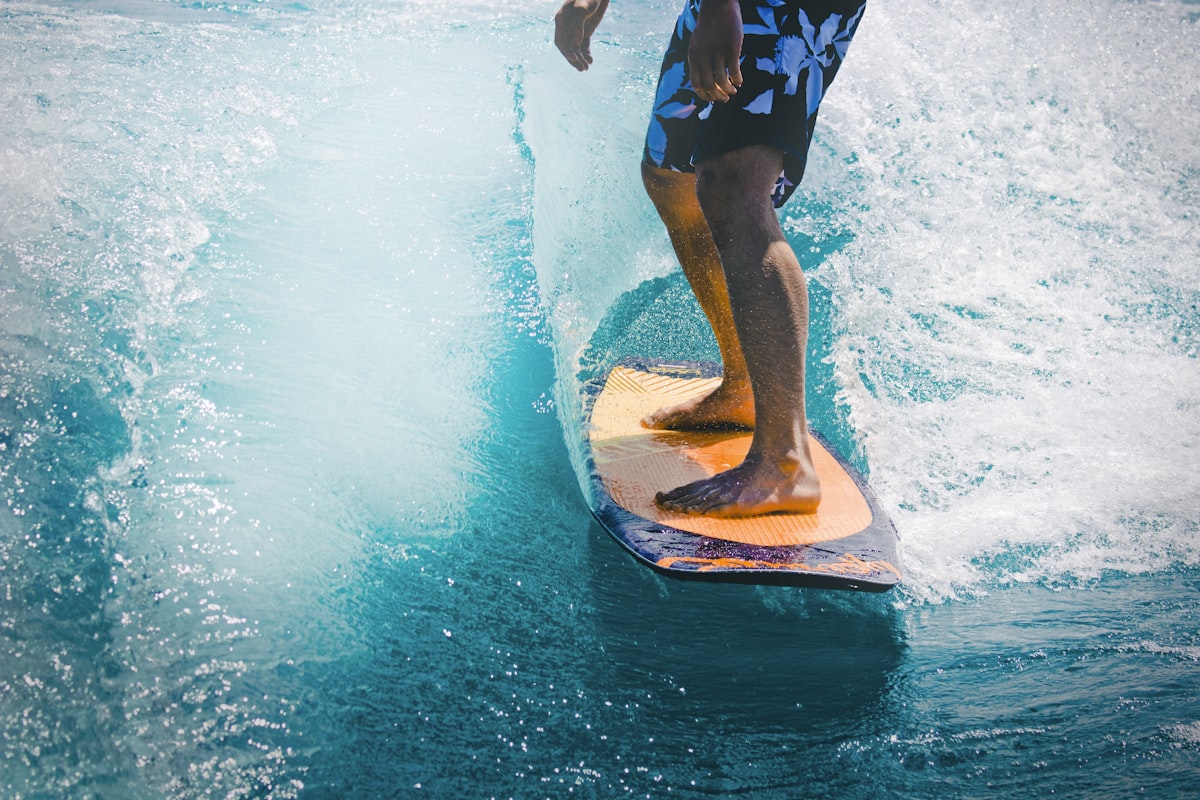
The One Thing That Separates Intermediate Surfers From Good Ones
Ask coaches for the most underrated skill. Most say vision.
Your head follows your eyes, your board follows your hips, and the rest of the chain follows from there.
Most surfers who plateau at the intermediate level have unconsciously developed a habit of looking at the wrong thing at the wrong moment. They stare at the nose on takeoff. They watch the lip break in front of them instead of the section ahead. They lock eyes with whitewater instead of finding the open shoulder. Each tiny vision error costs them speed, line choice, and eventually the wave.
The good news is that vision is one of the most learnable parts of surfing. You don't need to be stronger or fitter. You don't need a new board. You just need to know where to look — and practice looking there until it becomes automatic.
Why Vision Drives Everything
Your brain runs two visual systems in parallel. Focal vision is the small, high-resolution patch in the center of your gaze used to identify objects and lock onto a target. Peripheral vision is the wide, lower-resolution field that's incredibly good at detecting motion, edges, and balance cues.
When you stare down — at the deck of your board, at the trough, at the foam — you collapse your peripheral field. You lose your sense of where the wave is going, where the lip is pitching, where the shoulder is. You shrink your awareness to the small patch of water directly under your nose.
You also create a postural cascade. Looking down tilts your head down, which rounds your shoulders, which shifts your weight forward, which buries your nose, which kills your speed. Every downward glance is a small wipeout waiting to happen.
Looking ahead does the opposite. It lifts your head, lengthens your spine, opens your chest, balances your weight over your back foot, and floods your peripheral vision with every cue your balance system needs to ride a moving wave. Vision is the lever that moves the whole body.
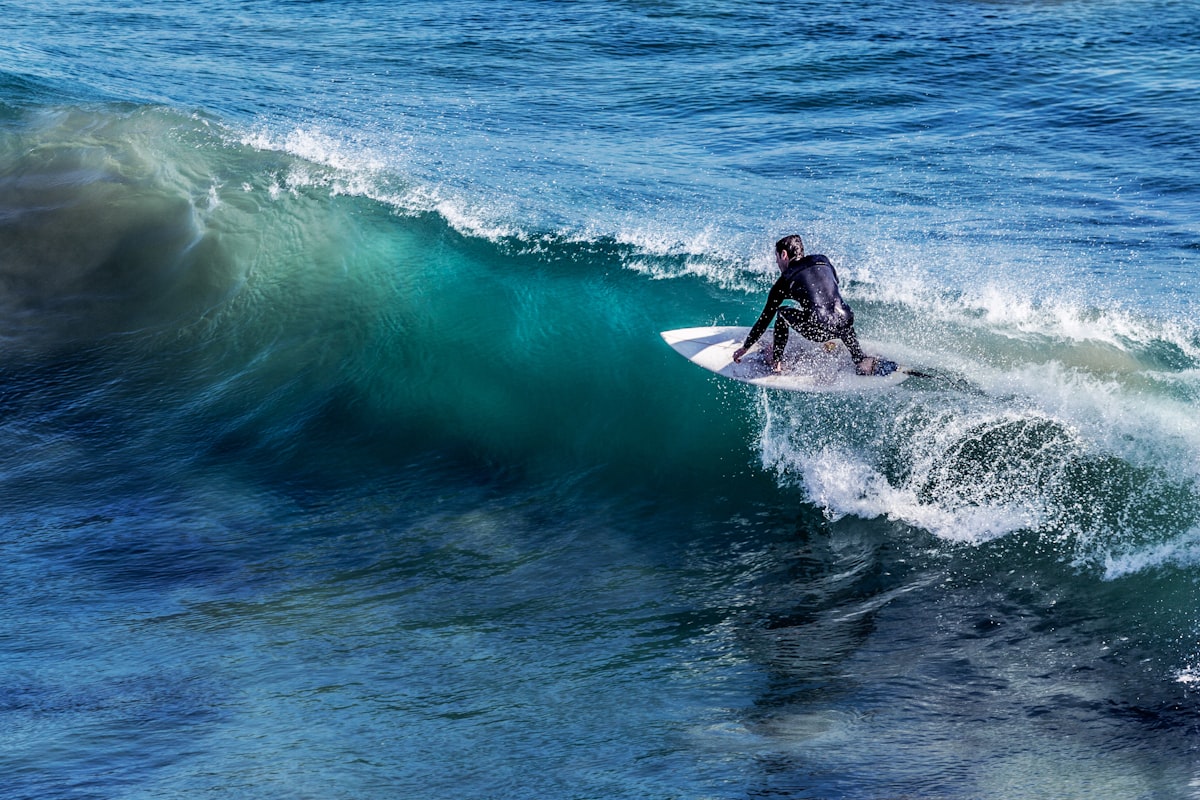
Phase 1: Paddling Out — Scan, Don't Stare
Vision discipline starts before you've caught a single wave.
Most surfers paddle out with their head down and their eyes on the water immediately in front of the board — a habit carried over from swimming, and wrong for surfing. The ocean demands you constantly update your model of what's happening around you. You can't do that with your face in the water.
The correct paddle-out posture has your head up just enough to see twenty to thirty yards ahead without straining your neck. From there, your eyes should scan in a steady rhythm: horizon, mid-distance, near, repeat.
- Horizon scan: Are sets coming? How big? Which direction?
- Mid-distance scan: Where are other surfers? Is the lineup drifting?
- Near scan: Is there foam, a board, or a swimmer in your immediate path?
A surfer who only looks down sees the wave when it's already on top of them. A surfer who only stares at the horizon misses the kid drifting into their lane. Trained eyes move on a loop and never lock in one place for long.
Phase 2: Choosing a Wave — Look Outside, Then Down the Line
When a set approaches, untrained surfers track the closest, biggest, most obvious wave. Trained surfers track the second or third wave back and the angle it will arrive at.
This matters because most surf decisions are made too late. By the time you've identified the wave you want, the wave behind it is already loaded and you've used up your decision window. The best surfers in any lineup are constantly looking past the first wave and asking: which is the one I actually want, and where do I need to be in thirty seconds to catch it?
Once you've picked your wave, your eyes have one more job before you turn around: look down the line and pick your exit point. Not the takeoff. The exit. Where on the wave do you want to be five seconds after you stand up? That projection is the line you'll commit to.
Phase 3: The Takeoff — Eyes Where You're Going, Not Where You Are
This is the single biggest vision error in all of surfing.
Watch any beginner or struggling intermediate take off. Their eyes go straight to the nose of the board, or to the trough directly below them. They stare at the drop they're scared of. The moment their eyes lock on the drop, their head drops, their shoulders round, their weight pitches forward, and they pearl, nosedive, or get bucked off.
The fix is brutally simple: look at where you want to go, not at where you are.
As you feel the wave pick up the tail and you push up into your stance, your eyes should already be down the line — at the shoulder, the section, the open face you identified before paddling. Your head turns first. Your shoulders follow. Your hips rotate. Your board angles into the line you're looking at. The drop happens almost by accident because your body is already doing the right thing.
This applies even on a steep, late takeoff. Especially on a steep, late takeoff. The instinct is to stare at the bottom of the wave because it looks terrifying. Override the instinct. Lift your eyes. The drop becomes a thousand times easier the moment your gaze is already at the bottom turn instead of at the trough.
Working on wave riding? Partner with Neptune on iPhone and Apple Watch.
Get the free appThe Cue: "Look at the Wall"
If you find yourself pearling repeatedly, give yourself a one-word cue to repeat as you paddle for the wave: wall. Not nose. Not drop. Not bottom. The wall. The unbroken face of the wave ahead of you. That cue trains your eyes onto the only thing that matters in the takeoff.
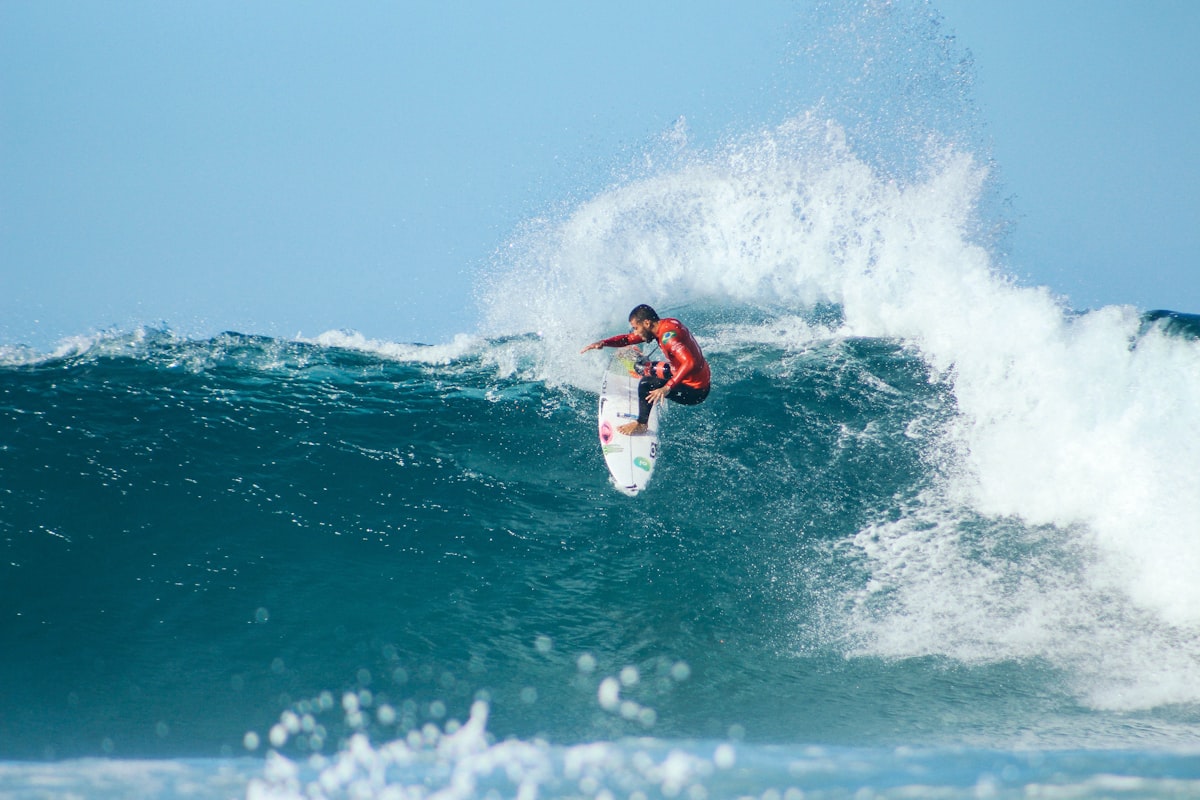
Phase 4: The Bottom Turn — Look at the Lip, Not the Trough
The bottom turn sets your speed, line, and rhythm for the entire ride that follows. Get it right and the rest of the wave opens up. Get it wrong and you're playing catch-up until you bail.
The vision instruction is counterintuitive: look up and ahead at the section of the lip you want to hit. Not at the bottom of the wave. Not at your board. At the part of the lip where you're going to redirect — typically a few yards ahead and up the face.
When you look at the lip, three things happen at once. Your head rotates across your body. Your shoulders open in the same direction. Your inside arm naturally extends toward where your gaze is going. Your weight shifts onto your inside rail. Your board carves up the wave on a perfect bottom-turn arc — all of that because your eyes told the chain where to go.
The most common mistake is looking at the trough or the foam directly in front of the board. That kills the turn. The board stays low on the wave, the rail doesn't engage, and the surfer drives into flat water instead of up the face. Every coach says some version of the same thing: look at the lip, throw your arm at it, your body will follow.
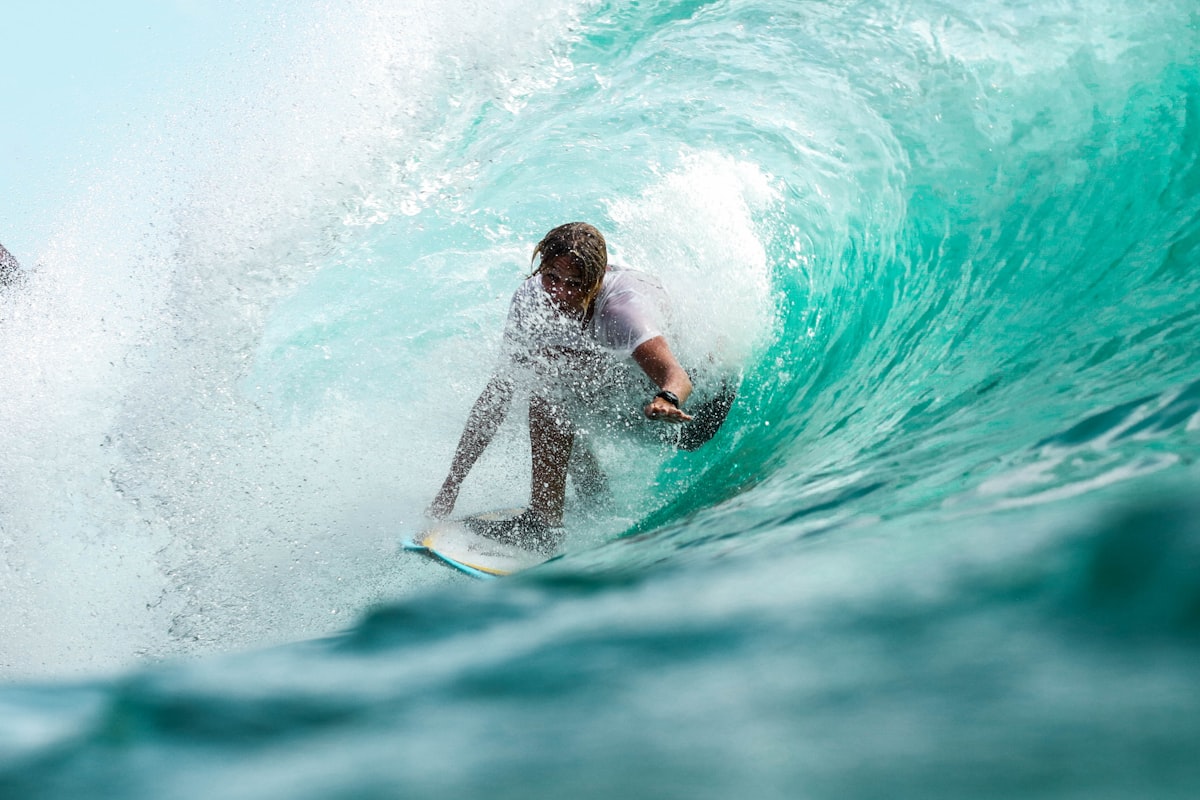
Phase 5: The Top Turn — Look at the Next Section
After you've hit the lip, your eyes need to move again — and they need to move before your body does.
The mistake here is staying focused on the spray, the lip impact, or the moment of redirection you just executed. That's the past. The next section of wave is the future, and your eyes need to be there already by the time the board comes back down.
As you reach the apex of your top turn, snap your gaze back down the line to the next feature of the wave: the next section that's going to wall up, the next pocket that needs to be filled, the open face you're projecting toward. Your head turns first, your shoulders follow, your hips rotate, your board redirects.
This is how flow works. Flow isn't a feeling — it's a vision rhythm. Surfers who look like they're dancing on the wave are constantly looking one phase ahead. Eyes lead at the bottom of the wave. Eyes lead at the top. Eyes lead through the cutback. The body is always responding to a gaze that's already moved on.
Phase 6: In the Pocket — Soft Focus, Wide Field
Once you're trimming and the wave is feeding you down the line, the gaze instruction changes from a single target to a soft, wide focus.
This is when peripheral vision earns its keep. Don't lock your eyes on any one thing in the pocket. Use a relaxed gaze, generally pointed down the line, that lets your peripheral field absorb the lip above you, the trough below you, and the wall ahead of you. Your brain integrates all of those motion cues into your sense of where you are on the wave — without ever having to focus on any one.
In the pocket, the only thing that snaps you back to hard focus is a decision. The lip starting to pitch ahead — hard focus on the section, plan a cutback or a tube. A surfer dropping in — hard focus on them, prepare to bail or pull around. Until a decision is required, stay soft.
Phase 7: The Barrel — Look at the Exit
The barrel gaze rule is simple and absolute: look at the exit. Look at the spot of light at the end of the tube. Not at the lip throwing over your head. Not at the wall. Not at your board.
This is the most extreme version of "your body follows your eyes" in all of surfing. If your gaze locks onto the lip above you, your weight goes back, your speed dies, and the foam ball catches you. If your gaze locks onto the wall ahead, your hips square up and you drive straight into it. Eyes on the exit also raises your head and opens your chest into the upright posture that lets you stall and accelerate inside the tube.
Phase 8: The Kick-Out — Look at Your Next Move
Even kicking out has a vision rule. As the wave closes out or fades, your gaze should already be back on the lineup. Where's the next set? Where do you want to be sitting? Is there a faster paddle-back lane?
The twelve-wave surfer is already planning the next paddle-out before they're off the wave. The three-wave surfer rides the wave, kicks out, looks around, gets pushed by foam, drifts inside, and burns a full minute realigning. Vision is the cheapest way to add waves to your session.
How to Train Your Eyes
Vision drills are unglamorous, but they work fast. Try these in your next few sessions:
Drill 1: The Verbal Commit
Before every wave you paddle for, say one word out loud (or in your head) that names where you're looking after takeoff: wall, shoulder, lip. Force the verbalization until it becomes automatic. Talking your eyes through the wave breaks the unconscious habit of staring at the nose.
Drill 2: The No-Down-Look Rule
For one entire session, commit to never letting your eyes drop below the horizon line of the wave. Not on takeoff. Not on bottom turns. Not while paddling. If you catch yourself looking down, you lose. You'll be shocked how often it happens — and how much faster you surf when it stops.
Drill 3: Head-Up Pop-Up Practice
Practice pop-ups on land or on a soft top in waist-deep water, focusing only on where your eyes go in the transition from prone to standing. Eyes should never touch the board. They should travel from the wave-face ahead-of-you on the paddle, to the same wave-face ahead-of-you when you're standing. The eyes never move. The body moves underneath them.
Drill 4: Watch Surf Video Differently
Pull up footage of any surfer you admire and watch only their head. Ignore the board. Ignore the spray. Watch where their face is pointed at every moment of the wave. You'll see their gaze leads everything by a fraction of a second. Now watch your own footage. The gap between those two is what stands between you and your next level.
The Mental Shift
Vision is a mental discipline. Looking ahead requires trusting that the part of the wave behind your eyes will take care of itself. It requires committing to a line before you can see how it ends. It requires giving up the false safety of staring at what's directly in front of you.
Looking at the nose feels safe. Looking at the drop feels honest. But it's exactly the wrong thing for surfing, because surfing is forward motion on a moving target, and the only useful information is where the wave is going to be in two seconds, not where it is right now.
Putting It All Together
Next time you paddle out, run through this mental checklist before you catch a wave:
- Paddling out: head up, scan horizon-mid-near in a loop.
- Choosing a wave: look past the first one, pick the exit before you turn.
- Takeoff: eyes on the wall, never on the nose.
- Bottom turn: eyes on the lip section you'll hit.
- Top turn: eyes on the next section before your board comes down.
- Trimming: soft focus, wide field, wait for a decision.
- Barrel: eyes on the exit, every time.
- Kick-out: eyes already back on the lineup.
You can ride better waves with the same fitness, the same board, and the same forecast — just by moving your eyes. The wave doesn't change. The surfer does. Lift your gaze, project your line, and the rest of your surfing will rise to meet it.
Read it. Then take it to the water.