How Waves Break

Neptune
June 11, 2026
The Most Important Event in Surfing
A wave breaking is the event that makes surfing possible.
How a wave breaks tells you where to sit and which ones will close out.
This guide breaks the whole thing down: why a wave breaks at all, the three fundamental ways it can break, what controls which one you get, and how to convert all of it into better decisions in the lineup.
Why a Wave Breaks at All
Out in deep water, a swell isn't really moving water across the ocean. It's moving energy through water. The water itself mostly stays put, rotating in circles as the energy passes through it — orbital motion that gets smaller and smaller the deeper you go. This is why a swell can travel thousands of miles across the Pacific while the water in the middle of the ocean barely goes anywhere.
So why does that orderly energy ever break? The answer is the bottom.
As a swell approaches shore, the water gets shallower. Once the depth drops to roughly half the wave's wavelength, the bottom starts to interfere with those circular orbits of water. The deep orbits get squashed and compressed. This process is called shoaling, and it changes the wave dramatically:
- The wave slows down as it drags against the bottom.
- The waves behind it bunch up, so the wavelength shortens.
- Because the same energy is now packed into a shorter, slower wave, the wave grows taller.
You've watched this happen a thousand times without naming it. A swell line that looked flat and harmless out the back suddenly stands up tall and steep as it reaches the sandbar. That standing-up is shoaling in action — the wave converting horizontal travel into vertical height.

The Moment of the Break
The wave keeps growing and steepening as it shoals, but it can't do this forever. The crest of the wave is now in shallower water than the trough ahead of it, which means the top of the wave is traveling faster than the bottom. The crest begins to outrun its own base.
There's a tipping point. When the water depth drops to about 1.3 times the wave height — equivalently, when the wave height reaches roughly 0.78 times the water depth — the wave becomes unstable. The crest can no longer support itself over the slower base beneath it. Gravity wins. The top pitches forward, and the wave breaks.
That ratio is the closest thing surfing has to a magic number. A wave breaks when it gets too tall for the water it's standing in. Memorize the principle, not the decimals: breaking is what happens when the top of the wave outruns the bottom. Everything else in this article is a variation on that single idea.
The Three Ways a Wave Breaks
Not all breaks are equal. The manner in which a wave collapses — gentle and crumbly, hollow and violent, or barely at all — is what surfers actually care about, because it determines whether the wave is forgiving, world-class, or unrideable. Coastal scientists classify breakers into three main types: spilling, plunging, and surging. Real waves live on a spectrum between them, but understanding the three pure forms lets you read any wave you'll ever paddle for.
The single biggest factor separating them is the steepness of the bottom the wave is breaking over. Gentle slopes make gentle waves. Steep slopes make violent ones. Hold that thought as we go through each type.
Spilling Breakers
A spilling breaker is the gentle one. The crest gets unstable and white water "spills" down the front of the wave gradually, tumbling down the face as the wave continues to roll forward. The wave doesn't pitch out into a hollow shape — it just feathers at the top and crumbles, often for a long time, peeling slowly toward shore.
Spilling breakers form over gently sloping bottoms, like the wide, shallow sandbars of a mellow beach break. Because the depth changes gradually, the wave has time to release its energy slowly over a long distance rather than all at once. The result is a soft, forgiving, slow-motion crumble.
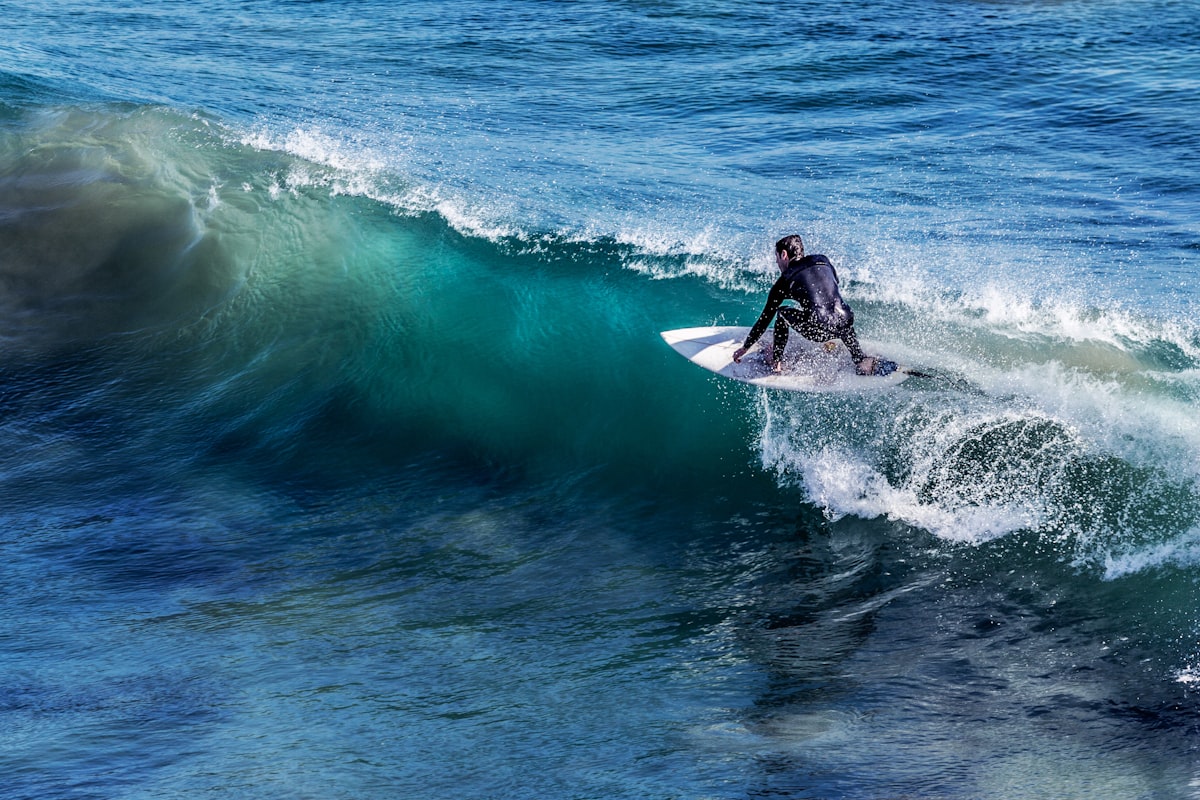
For learners, spilling breakers are the best waves on Earth. They're stable, predictable, and they give you a long, gentle push without trying to drive you into the sand. The classic "whitewater" waves beginners practice their pop-ups on are spilling breakers that have already broken and are reforming as foam. The trade-off is that they lack power and a steep face, so as you advance you'll start craving something with more punch.
Plunging Breakers
Working on reading waves and forecasts? Partner with Neptune on iPhone and Apple Watch.
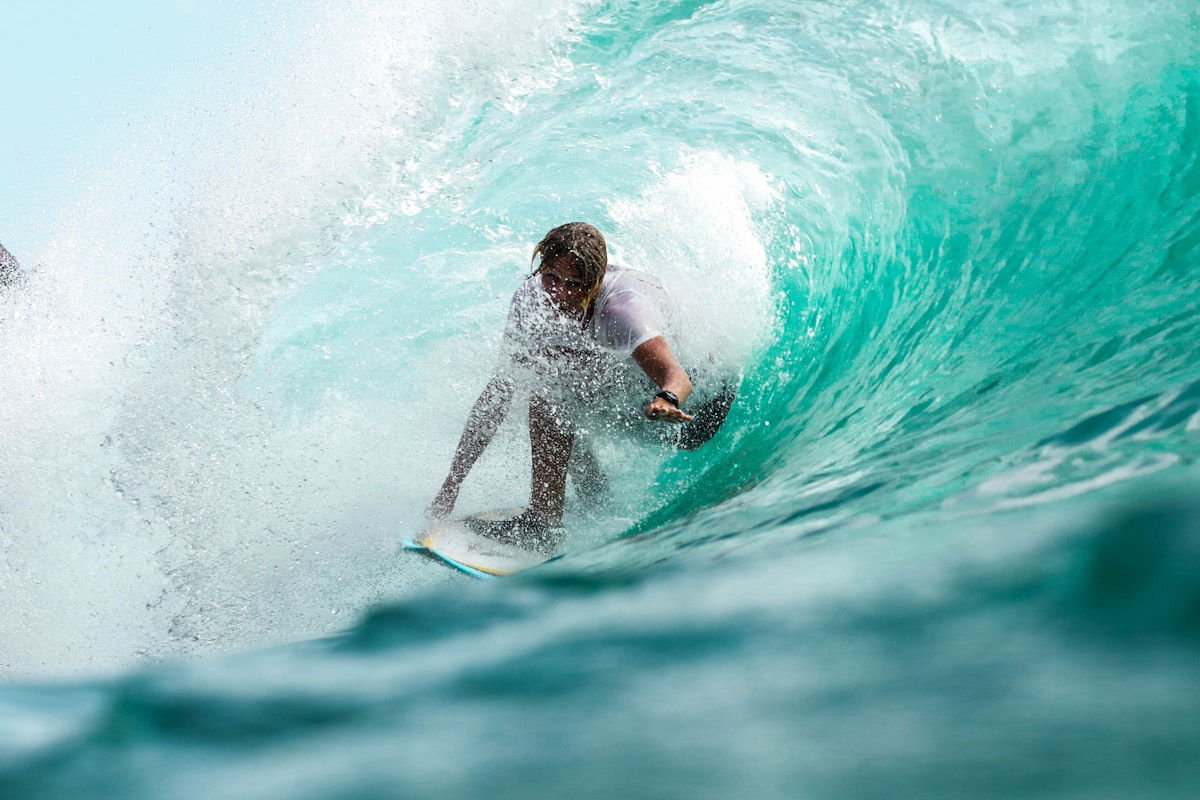
Get the free appA plunging breaker is the one on the posters. The crest doesn't crumble gently — it throws forward violently, arcing out over the trough and slamming down in front of the wave. For a moment the wave forms a hollow, near-vertical face with a tube of open air inside it: the barrel. This is the most powerful, most coveted, and most dangerous way a wave can break.
Plunging breakers form over steep bottoms — reefs, ledges, rock shelves, or abruptly shallow sandbars. The depth changes so suddenly that the wave has no time to release its energy gradually. It all comes out in one explosive instant. The crest pitches because the base of the wave hits the shallow bottom and stops almost dead while the top keeps charging, launching the lip out into the air.
This is where the best and heaviest waves in the world live — the barrels of Pipeline, Teahupoʻo, and a thousand reef and point breaks. It's also where surfers get hurt. The energy that makes a plunging wave thrilling is the same energy that drives bodies into reef and holds them down. Plunging waves demand respect, experience, and usually a shallow, unforgiving bottom you'd rather not get acquainted with.
Surging Breakers
The third type is the one surfers rarely ride and beginners should genuinely fear: the surging breaker. Here the wave never really forms a breaking crest at all. It rushes up a very steep beach face as a sudden wall of water, surging up the slope and sucking back down, often without ever curling or producing white water out in front.
Surging breakers form over very steep bottoms — think a shore that drops off sharply right at the sand, the classic steep-beach shorebreak. The wave reaches the shallow zone so abruptly that it doesn't have room to peel or barrel; it simply heaves up and detonates right on the sand.
Surging shorebreak looks deceptively small and is responsible for a startling number of neck, shoulder, and spinal injuries — including to strong swimmers who underestimate it. A two-foot wave breaking directly onto dry sand with all its energy intact will pick you up and drive you headfirst into the beach. There's nothing to ride and nothing to gain. Recognizing surging shorebreak and staying out of its impact zone is pure ocean safety.
What Decides Which Kind of Break You Get
If the bottom slope were the only factor, every spot would break exactly the same way every day. But you've seen the same beach go from gentle and crumbly to hollow and heavy as conditions change. Several variables interact to determine the break on any given day.
Bottom Slope and Shape
This is the dominant factor and the one we've covered: gentle slope → spilling, steep slope → plunging, very steep → surging. It's also why bottom type defines a spot's character. A sandy beach break with shifting bars tends toward spilling and the occasional plunging peak. A reef or point with a fixed, steep takeoff zone tends toward consistent plunging waves — which is exactly why the world's best barrels are reef and point breaks, not beach breaks.
Swell Period and Steepness
A wave's steepness — its height relative to its length — strongly influences how it breaks. Short-period wind swell arrives steep and disorganized, and tends to spill and crumble weakly. Long-period groundswell arrives with long wavelengths carrying enormous energy deep in the water column. When that energy finally feels the bottom, it stands up fast and hollow, favoring powerful plunging breaks. This is a big part of why experienced surfers obsess over swell period: a long-period swell doesn't just mean bigger waves, it means better-shaped, more powerful breaks over the same sandbar.
Tide
Tide changes the effective depth over the bottom, which shifts the break type in real time. A low tide draws the water down over a reef or sandbar, making the bottom relatively steeper and the waves hollower and more punchy — sometimes too hollow, closing out or barreling onto dry reef. A high tide adds water, softening the slope's effect and making waves fatter, slower, and more spilling — sometimes too fat to break at all. Every spot has a tide window where the depth produces its best break, and learning that window is one of the most valuable things you can know about your home break.
Wind
Wind doesn't change the break type the way the bottom does, but it shapes the quality of the break. Offshore wind (blowing from land out to sea) holds the lip up, grooms the face smooth, and helps a wave stand tall and hollow before it breaks — it makes plunging waves cleaner and more makeable. Onshore wind (blowing from sea to land) pushes the crest over early, makes waves break prematurely and crumbly, and turns clean lines into mush. Same swell, same sandbar, opposite wind — completely different wave.

How a Wave Peels — and Why It Matters
So far we've talked about how a wave breaks. Just as important to a surfer is where along the wave it breaks first, and in which direction the break travels. That's peeling, and it's the difference between a rideable wave and a close-out.
When a wave hits a sandbar, reef, or point at an angle, it doesn't break all at once along its whole length. One section reaches the critical shallow depth first and starts breaking, and the break then runs sideways along the wave as each successive section reaches its own breaking point. That sideways-traveling break is the peel, and the speed at which it travels — the peel rate — sets the pace you have to surf at to stay with the wave.
- A wave that peels slowly gives you all day to make your sections. Forgiving, playful, beginner-friendly.
- A wave that peels fast demands speed and commitment; fall behind and the section closes out ahead of you.
- A wave that doesn't peel at all — breaking along its entire length simultaneously — is a close-out. There's no open face to ride down the line. Close-outs happen when a swell hits a sandbar straight-on rather than at an angle, which is why even a head-high beach break can be a frustrating wall of close-outs on the wrong swell direction.
This is the whole reason point breaks and reefs are so prized. Their fixed, angled bottom contours make waves peel at a consistent, predictable rate, in a consistent direction, every single time. A beach break's sandbars shift constantly, so its peel is a lottery that changes with every storm and tide.
Reading the Peel from the Beach
Before you paddle out, stand on the sand for ten minutes and watch where waves break first and which way they peel. Are they peeling cleanly right or left, or slamming closed all at once? Is there a defined peak where the wave bends and breaks in both directions? That peak is exactly where you want to sit — at the apex of the break, where you can choose your direction and drop in with the most open face ahead of you. Surfers who skip this step paddle out blind and spend the session in the wrong spot, wondering why every wave closes out on them.
Turning the Science Into Better Surfing
All of this theory pays off in concrete decisions. Here's how to use it on your next session.
Sit where the wave first becomes critical. The peak — where the wave stands up and begins to break — is the highest-percentage spot in the lineup. Read the shoaling: watch where swell lines first stand tall, and position yourself just outside and to the side of that point so you can drop in as the wave reaches its breaking depth.
Match the wave type to your skill and your goal. Learning to pop up and trim? Find gentle spilling breakers over a sandy bottom. Chasing your first barrel? You need a plunging wave over a steeper bottom — and the experience to handle the consequences. Never confuse the two. A plunging reef wave is not the place to practice fundamentals.
Use the tide deliberately. If your spot is closing out and breaking too hard, a pushing tide may soften it into something makeable. If it's fat and not breaking, a dropping tide may sharpen it up. Don't just check the tide height — learn how your spot's break changes across the tide and plan your session around its best window.
Respect surging shorebreak. If you see waves detonating directly onto a steep beach with no peel and no shoulder, that's a surging break, and there's nothing to ride and plenty to get injured by. Walk down the beach to where the bottom is gentler, or pick a different spot entirely.
Read steepness on the forecast. A long-period groundswell with offshore winds and the right tide is the recipe for clean, powerful, well-shaped breaks. Short-period onshore slop over a flat sandbar is the recipe for weak, crumbly, hard-to-read waves. The forecast is telling you not just how big the waves will be, but how they'll break — if you know how to read it.
The Whole Picture
Here's the entire arc in one breath. A swell travels across the open ocean as pure energy, the water barely moving. It reaches the coast, feels the bottom, and shoals — slowing, shortening, and standing tall. When the wave gets too steep for the water it's standing in, the crest outruns the base and the wave breaks. How it breaks — spilling soft, plunging hollow, or surging onto the sand — is governed mostly by the steepness of the bottom, refined by swell period, tide, and wind. And where it breaks first, and how fast the break peels along the wave, decides whether you get a dream ride or a close-out.
None of this is visible to the surfer who sees only "a wave." But once you can watch a swell line stand up and predict how it will break before it breaks — once you can read shoaling, anticipate the peel, and pick the peak from the beach — the ocean stops being random. You sit in the right spot. You paddle for the makeable wave and let the close-out go. You read a new beach in minutes instead of seasons.
The wave was always going to break exactly the way physics demanded. Now you can see it coming.
Read it. Then take it to the water.