Beach Breaks, Point Breaks, and Reef Breaks

Neptune
March 24, 2026

Why Understanding Wave Types Matters
A solid pop-up and a good forecast still fail if you do not know the wave type.
The ocean floor decides how a wave peels, how fast it is, and how much risk it carries.
Every surf spot in the world falls into one of three broad categories: beach breaks, point breaks, or reef breaks. Each type has its own personality, its own advantages, and its own hazards. Understanding these differences won't just make you a smarter surfer — it will help you choose the right spots for your skill level, position yourself better in the lineup, and ultimately catch more waves.
This guide breaks down each wave type in detail so you can walk up to any coastline and immediately understand what the ocean is doing and why.
Beach Breaks: The Most Common Wave You'll Surf
Beach breaks are waves that break over a sandy bottom. They're by far the most common type of surf spot worldwide, and they're where the vast majority of surfers learn to ride waves.

How Beach Breaks Work
When a swell approaches the shore and encounters a sandy seabed, the wave slows down as the water becomes shallower. Sandbars — ridges and mounds of sand shaped by currents, tides, and previous swells — create the uneven bottom contour that causes waves to peak and break in specific locations.
The key thing about sand is that it moves. Unlike rock or coral, sandbars are constantly shifting. A storm can reshape the bottom in a single day. This means beach breaks are inherently unpredictable and changeable. The spot that was firing last Tuesday might be flat and disorganized today, not because the swell changed, but because the sand moved.
Characteristics of Beach Breaks
- Shifting peaks: Waves don't break in the same spot every time. You'll need to constantly adjust your position in the lineup.
- Multiple peaks: A long stretch of beach might have several sandbars, each producing its own peak. This spreads the crowd out.
- Varied wave shape: On any given day, you might see hollow barrels, mushy rollers, and closeouts all within the same stretch of beach.
- Closeouts are common: When sandbars are flat or poorly shaped, waves tend to break all at once across their length instead of peeling left or right. This is the biggest frustration of beach break surfing.
- Forgiving wipeouts: Sandy bottoms are far more forgiving than rock or coral. You can fall without worrying about getting cut or hitting a reef shelf.
How to Surf Beach Breaks Well
Watch before you paddle out. Spend at least 10-15 minutes observing from the beach. Look for where waves are consistently peaking — that's where the best sandbar is. Note where rip currents are flowing, as these often sit in the deeper channels between sandbars.
Stay mobile in the lineup. Don't anchor yourself to one spot. Beach break surfing rewards surfers who are willing to move. If the peak shifts 30 yards down the beach, follow it.
Be selective. Because beach breaks produce inconsistent waves, it's tempting to paddle for everything. Resist that urge. Wait for the waves that actually have a shoulder — a section that peels rather than closing out. You'll catch fewer waves but ride better ones.
Use the rip currents to your advantage. The same rips that can be dangerous for swimmers are useful for surfers. Paddle out through the rip channel (the deeper water between sandbars) to conserve energy, then position yourself on the sandbar next to it.
Best Beach Breaks for Different Levels
- Beginners: Look for wide, gently sloping beaches with small, slow-breaking whitewater. The mushier the wave, the easier it is to learn on.
- Intermediates: Seek out spots known for well-shaped sandbars that produce peeling waves. Ask locals or check Neptune's spot guides for reliable banks.
- Advanced: Beach breaks can produce world-class waves when sandbars align perfectly. Spots like Hossegor in France and Puerto Escondido in Mexico are beach breaks that regularly produce heavy, barreling waves.
Point Breaks: The Long, Peeling Dream
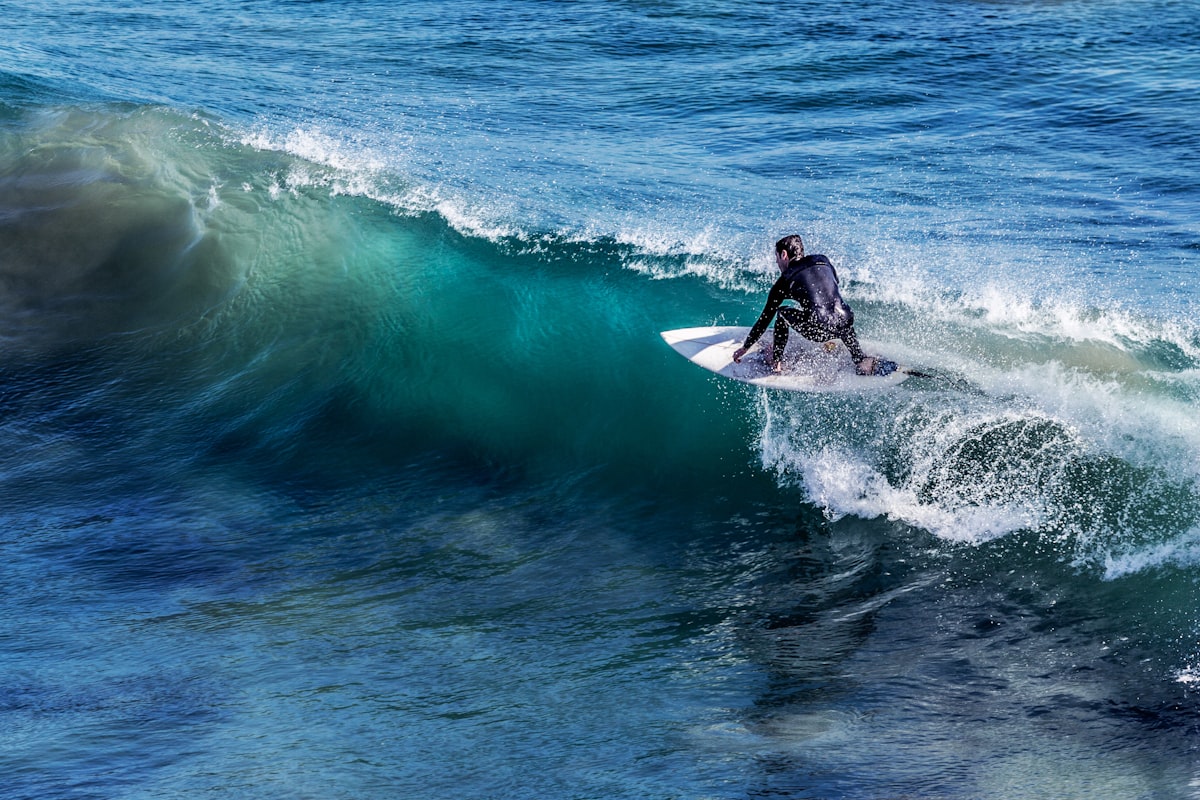
Point breaks are waves that break along a point of land — usually a headland, rocky outcrop, or jetty that juts out into the ocean. They're widely considered the most desirable type of wave because of their long, predictable walls.
How Point Breaks Work
When a swell wraps around a point of land, it bends (a process called refraction) and begins breaking along the contour of the coastline. Because the bottom — usually a combination of rock, boulders, and sand — stays relatively consistent, the wave peels in a long, orderly line from the point toward the inside.
This creates something magical: a wave that breaks in almost exactly the same spot, at almost exactly the same angle, every single time. Where beach breaks are chaotic, point breaks are the picture of order.
Characteristics of Point Breaks
- Consistent takeoff zone: The wave always starts breaking at the same point (called "the top of the point"), so you know exactly where to sit.
- Long rides: Because the wave peels along the coastline, rides can last 100 yards or more at quality point breaks. Some famous points offer rides of 300+ yards.
- One direction only: Point breaks almost always break in one direction — either left or right, depending on the orientation of the point relative to the swell.
- Predictable sections: You'll quickly learn the wave's personality — where it bowls, where it fattens out, where you can do a turn, and where you need to pump for speed.
- Crowded lineups: Because point breaks are so desirable and the takeoff zone is a single concentrated spot, crowds can be intense. Lineup hierarchy and etiquette matter enormously at point breaks.
How to Surf Point Breaks Well
Working on reading waves and forecasts? Partner with Neptune on iPhone and Apple Watch.
Get the free appStudy the wave's rhythm. Point breaks often have a cadence — sets come in regular intervals, and each wave in a set behaves similarly. Spend time watching from the rocks or the cliff above to map out the wave's sections before your session.
Start on the inside. If you're new to a point break, don't paddle straight to the top of the point where the best surfers are sitting. Start on the inside section and work your way up as you gain confidence and understand the wave.
Commit to the drop. Point break takeoffs can be steep and fast, especially at the top of the point where the swell first hits the bottom contour. Hesitation leads to late drops and getting caught behind the curtain. When it's your wave, paddle hard and commit.
Think ahead. The beauty of a point break is that you can see the wave ahead of you. Use that information. If you see a section about to bowl up 30 yards down the line, start setting up your bottom turn early to generate the speed you'll need.
Respect the locals. Point breaks, more than any other wave type, tend to have strong local crews. The takeoff zone is small, the waves are precious, and regulars have often surfed the spot for decades. Be respectful, wait your turn, and don't snake the peak.
Famous Point Breaks Around the World
- Jeffreys Bay, South Africa: One of the fastest, longest right-hand point breaks on Earth. On a solid swell, you can ride for over 300 yards through multiple sections, each with its own character.
- Rincon, California: Known as the "Queen of the Coast," this right-hand point produces perfectly lined-up walls from fall through spring.
- Raglan, New Zealand: A series of left-hand point breaks that peel along the coastline with mechanical perfection.
- Chicama, Peru: Often cited as the longest left in the world, with rides reportedly stretching over a mile on the biggest swells.
Reef Breaks: Power, Precision, and Respect
Reef breaks are waves that break over a hard, fixed bottom — usually coral reef, volcanic rock, or limestone shelves. They produce some of the most powerful and perfectly shaped waves on the planet, but they also carry the most risk.

How Reef Breaks Work
The hard, immovable bottom of a reef creates an abrupt change in water depth. When a swell passes over a reef shelf, it's forced upward suddenly, which causes the wave to jack up and throw over with more power and intensity than a gradual sandy slope would produce.
Because the reef doesn't move, the wave breaks in the exact same spot every time. This consistency is what produces the perfectly shaped barrels and walls that reef breaks are famous for. The shape of the reef dictates the shape of the wave — a steeply angled reef produces hollow, barreling waves, while a more gradual reef shelf produces mellower, more sloping faces.
Characteristics of Reef Breaks
- Extremely consistent: The wave breaks in the same location with the same shape, swell after swell. This makes them the most predictable wave type to surf once you've learned the spot.
- Powerful and hollow: The abrupt depth change produces waves that are steeper and more powerful than beach breaks of the same size. Many reef breaks produce barrel-worthy waves even at smaller sizes.
- Defined channel: Most reef breaks have a clear deep-water channel next to the breaking wave. This makes paddling out straightforward — you paddle through the channel, not through the impact zone.
- Shallow hazard: This is the trade-off. When you fall at a reef break, there's a hard, sharp bottom below you. Coral can cause serious lacerations. Shallow reef shelves can cause impact injuries. The risk is real and must be respected.
- Tide-dependent: Reef breaks are often very sensitive to tide changes. Too low, and the wave jacks up dangerously over dry reef. Too high, and the wave may not break at all or lose its shape. There's usually a sweet spot — often mid-tide — when the wave is at its best.
How to Surf Reef Breaks Safely
Know the spot before you paddle out. This isn't optional. Talk to locals, study the reef at low tide if possible, and understand where the shallow sections are. Know where the channel is and where the safe zones are if you fall.
Understand the tide window. Ask other surfers or check local reports to learn what tide the spot works best at. Many reef breaks become genuinely dangerous at low tide, with only inches of water over the reef in the impact zone.
Fall flat, not deep. If you wipe out over reef, fight your instinct to dive deep. Instead, try to fall as flat as possible — spread your body to increase surface area and reduce how deep you sink. Cover your head with your arms as you surface.
Wear reef booties. At sharp coral reef breaks, thin neoprene booties can prevent painful cuts when you inevitably make contact with the bottom. Many experienced reef surfers in the tropics wear booties even in warm water specifically for reef protection.
Know your limits. Reef breaks amplify consequences. A mistake at a beach break means you eat some sand. A mistake at a reef break can mean stitches, a broken board, or worse. Be honest about your ability level. There's no shame in watching from the channel on a big day.
Carry basic first aid. Reef cuts are common and reef organisms can cause infections. Having antiseptic, butterfly bandages, and waterproof adhesive tape in your car is a smart habit when surfing reef breaks regularly.
Famous Reef Breaks Around the World
- Pipeline, Hawaii: The benchmark for heavy, shallow reef breaks. Breaks over a series of reef shelves with just a few feet of water beneath the wave.
- Teahupo'o, Tahiti: Perhaps the heaviest wave in the world. Breaks over a razor-sharp coral reef with almost no water on the shelf. Reserved for elite surfers only.
- Uluwatu, Bali: A long, barreling left-hander that breaks over limestone reef. More forgiving than Pipeline but still demands respect.
- Cloudbreak, Fiji: A powerful left that breaks over a coral reef a mile offshore. Produces massive, perfectly shaped barrels on solid south swells.
How to Identify What You're Surfing
When you arrive at a new spot, here's a quick checklist to figure out what type of break you're dealing with:
Look at the bottom. Can you see sand? Rocks? Coral? If you can wade in and feel the bottom, that tells you immediately.
Watch where the waves break. If they break in different spots on every set, it's likely a beach break. If they consistently break in the same spot, it's a reef or point break.
Check the coastline shape. Is there a headland or point of land nearby? If waves are wrapping around it, you're looking at a point break.
Look for a channel. Reef breaks and point breaks usually have an obvious deep-water channel where waves don't break. Beach breaks are more uniform.
Observe the wave shape. Reef breaks tend to be steeper and more hollow for their size. Beach breaks tend to be mushier and more variable. Point breaks peel in an orderly line.
Ask locals. When in doubt, ask someone who surfs there regularly. They'll tell you everything you need to know about the bottom, the hazards, and the best conditions.
Adapting Your Surfing to Each Wave Type
Once you understand the type of wave you're surfing, you can make smarter decisions about everything from board choice to positioning.
Board Selection by Wave Type
- Beach breaks: Mid-length boards, fish shapes, and grovelers work well because beach breaks are often smaller and less powerful. Extra volume helps with the paddle battle of constantly repositioning.
- Point breaks: Performance shortboards shine here because the long, open walls give you room for turns and speed. A step-up is warranted when the swell gets overhead.
- Reef breaks: A board with enough rocker to handle steep drops and hollow sections. For bigger reef breaks, a step-up or gun with extra length and a pulled-in tail provides the control you need.
Positioning Strategy
- Beach breaks: Sit wide and stay mobile. Be ready to paddle to the peak rather than waiting for it to come to you.
- Point breaks: Sit at the top of the point for the longest rides. Be aware of the pecking order and don't burn surfers who are deeper than you.
- Reef breaks: Sit in the channel and paddle into position when you see your wave approaching. Use landmarks on shore to line up your exact takeoff spot.
Risk Management
- Beach breaks: Primary risks are rip currents and closeout hold-downs. Lower consequences for wipeouts.
- Point breaks: Rocks along the point and getting caught inside on the long paddle back out. Moderate consequences.
- Reef breaks: Reef lacerations, shallow-water impacts, and hold-downs in heavy surf. Highest consequences. Respect the wave's power and your own limits.
The Bottom Line
Every wave is a product of the ocean floor beneath it. Understanding whether you're surfing a beach break, point break, or reef break changes how you approach the session — from where you sit, to what board you ride, to how you manage risk.
As you travel to new spots and expand your surf horizons, this knowledge becomes your foundation. You'll be able to walk up to an unfamiliar coastline, assess the wave in minutes, and make informed decisions about how to surf it safely and effectively.
The best surfers aren't just athletic — they're students of the ocean. The more you understand about how waves work and why they break the way they do, the more waves you'll catch and the better those rides will be. So next time you paddle out, take a moment to appreciate the seafloor beneath you. It's shaping every wave you'll ever ride.
Read it. Then take it to the water.