How to Surf Reef Breaks Safely

Neptune
May 24, 2026
Why Reef Breaks Are Different
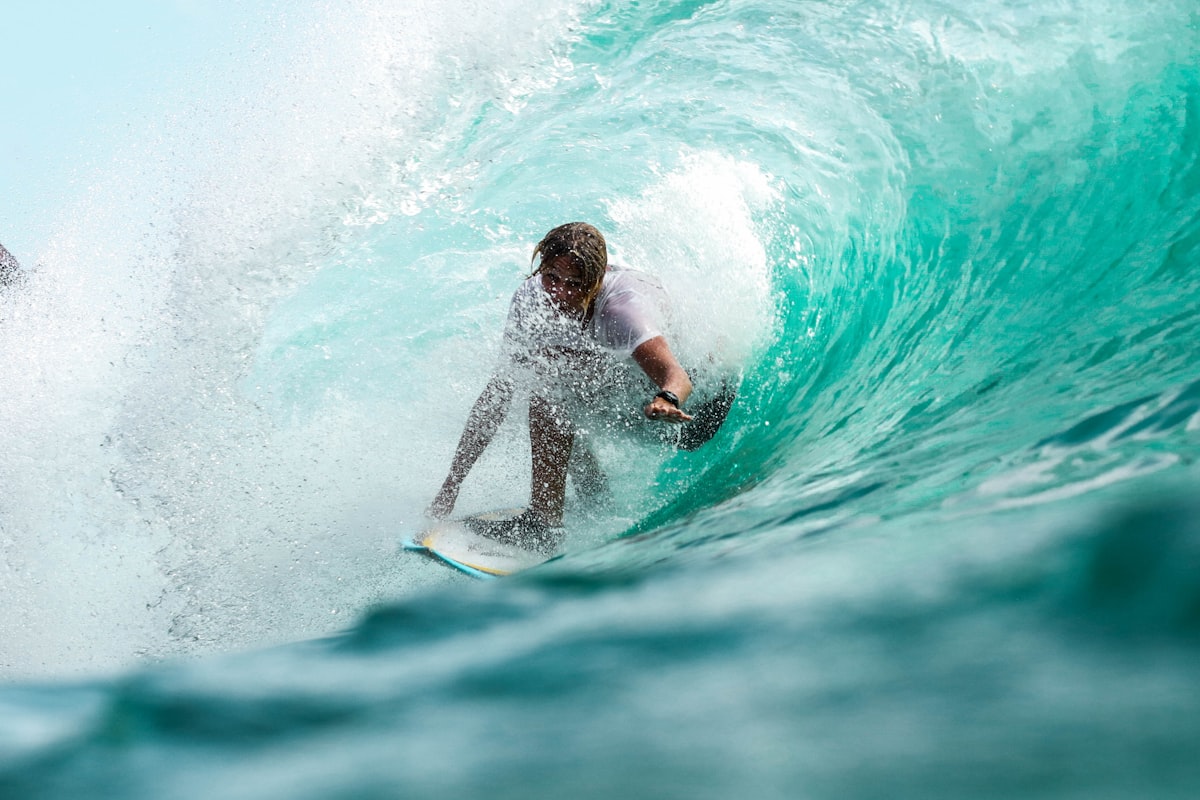
Reef waves are cleaner and the takeoff is more defined. The bottom does not forgive a bad fall.
Most surfers learn on sand. A reef is a different contract.
The good news is that reef breaks reward the kind of surfing that beach breaks make difficult. The wave shape is predictable. The takeoff is repeatable. Once you understand how to surf reef safely, you're surfing the most consistent waves on the planet.
This guide is about making that transition — without paying the price most beginners pay in skin and scar tissue.
Understand What You're Surfing Over
Before you ever paddle out at a reef, you need to know what kind of reef it is. The word "reef" covers a huge range of bottoms, and they behave very differently.
Coral Reef
Common in the tropics — Indonesia, the Maldives, Fiji, French Polynesia, parts of Mexico and Central America. Coral is sharp, slow to heal, and full of bacteria that thrive in warm water. A small coral cut can become a serious infection within 24 hours. Coral is also fragile: standing on it, dragging your fins, or hitting it with your board damages a living organism that takes decades to grow back.
Rock and Lava Reef
Common in Hawaii, the Canaries, parts of Australia, and most temperate-water reefs. Lava rock tends to be jagged and porous; granite and basalt reefs are smoother but still hard enough to crack a board or a head. Rock cuts heal faster than coral cuts but are no less serious in the moment.
Urchin-Covered Reef
A specific hazard in some tropical and temperate reefs. Sea urchin spines break off in your foot, are nearly impossible to remove fully, and can take weeks to dissolve. A single step on a wading exit can ruin a trip.
Knowing Your Reef in Advance
Before a reef trip, ask in detail: what is the bottom like, how deep is it at high and low tide, and where are the safe entry and exit points? Don't accept a vague answer. Specific knowledge changes how you'll surf the wave.
Read the Tide Like Your Life Depends on It
At a beach break, tide matters. At a reef, tide is everything.
A reef that breaks waist-deep at high tide can be exposed-rock at low tide. A wave that's fat and rideable at mid-tide can turn into a slabby closeout two hours later. The takeoff spot might be safe to fall on a high incoming and a guaranteed injury on a low push.
Build a Tide Window Mental Map
For any reef break, learn three numbers: the minimum tide it's safe to surf (below this, the reef is exposed), the optimum tide for wave quality (usually a 1-3 hour window), and the maximum tide (above which the wave gets too fat). Locals will tell you these numbers if you ask. The people who get hurt on reef are almost always the people who pushed through the bottom of the tide window because they didn't want their session to end.
Watch the Tide While You Surf
A two-hour surf on a falling tide can take you from safe to dangerous without you noticing. Train yourself to look at the reef on the inside between sets. If you can see exposed rock or coral that wasn't visible when you paddled out, it's time to make your way to the channel and exit.
Choose the Right Board
Reef breaks generally reward boards with a bit more rocker and a thinner profile than what you'd ride at a beach break. The wave is steeper and more critical on the takeoff. You want a board that can drop in late, hold a high line, and react quickly when the section pulls forward.
The second consideration for reef is board damage tolerance. Fins will get bent. Tails will get cracked. Many traveling surfers bring a dedicated "reef board" — a slightly more durable construction (epoxy or sandwich), often a model they've ridden before. Bring at least two boards if you can. A snapped board on day one of a ten-day trip with no surf shop nearby is a sad story.
Master the Channel
Every good reef break has a channel — a deeper section of water adjacent to the wave where the swell doesn't break. The channel is your highway: you paddle out through it, back to the peak through it, and exit through it.

Identify the channel before you put on your wetsuit. Look for darker water beside the breaking wave (depth), less foam (waves don't break there), and surfers using it (watch how locals enter and exit).
When you wipe out, get to the channel as fast as possible. Don't paddle straight back to the peak through the impact zone — that's how you get caught inside, dragged across reef, or worse. Paddle around. The extra two minutes is the price of admission.
The Pre-Paddle Checklist
Before paddling out at a reef break — especially a new one — run through this mentally:
- What's the tide doing now, and what will it do during my session?
- Where exactly is the takeoff? Pick a triangulation point on land.
- Where is the channel? Both for paddle-out and exit.
- Where is the worst section of the reef?
- What's the wind doing? Onshore can push you toward the reef on the inside.
- Where will I exit?
Working on reef breaks? Partner with Neptune on iPhone and Apple Watch.
Get the free appNinety seconds of planning saves a trip to a clinic.
How to Fall on a Reef
Falling on a reef is the single most important skill you can develop. Beach break surfers learn to fall any way they want — flat, head-first, ragdoll. On a reef, those habits will hurt you.
Fall Flat, Not Deep
On a reef break, the water gets shallower as the wave breaks. Don't dive. Don't try to swim down. When you wipe out, fall flat and stay flat. Cover your head with your arms and let the water push you. Spreading your body out distributes your impact across a larger area and keeps you from punching into a rock with one hand or foot.
Protect Your Head
The reflex to put your hands out when you fall is wrong on reef — hands hit rocks first and hard. Tuck your arms over your head, fists at the back of your neck, elbows shielding your face. This is the standard "starfish under attack" position used at reef breaks worldwide.
Slide, Don't Stop
If you hit reef, try to slide rather than slam. A scrape across coral hurts a lot less than a punch into it. The reflex to stand up and stop yourself the moment your feet touch bottom is what gets people cut up. Stay flat, stay sliding, and let the water carry you until it deposits you somewhere safe.
Pop-Up Discipline at the Takeoff
The reef takeoff is the most consequential moment of any reef session. A bad pop-up here doesn't just cost you the wave — it can put you on the reef in front of it.
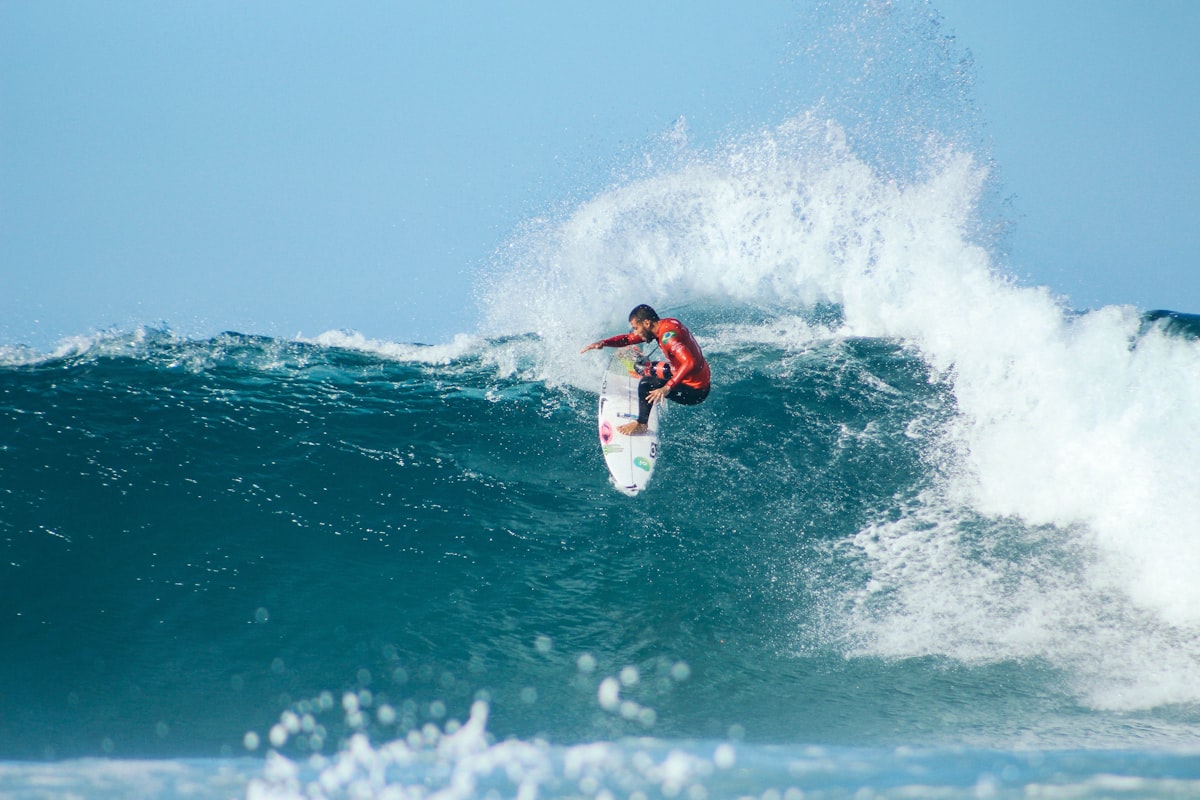
Three rules that matter more on reef than anywhere else:
Commit or Don't Go
The half-committed takeoff is the most dangerous one. You start to go, hesitate, and end up pearling or getting sucked over the falls. Either commit fully to the wave or pull back early — the middle ground is the injury zone.
Paddle Hard, Pop Up Late
Reef waves stand up faster than beach break waves. Paddle at full speed before the wave reaches you and delay your pop-up until you're already sliding down the face. A premature pop-up at a reef takeoff means you stand on top of the wave instead of inside the drop, which usually ends in a free-fall.
Know Your Pull-Back Line
For every wave, know in advance the moment past which you can't safely pull back. Pulling back into the lip is one of the most common reef-injury scenarios. If you've decided not to go, decide early, kick your board away from the impact zone, and dive deep.
Wear the Right Gear
Beach break surfers can get away with the bare minimum: board, leash, wax, suit. Reef surfers, especially at sharper reefs, benefit from a few additions.
Reef Booties
Booties are not a cop-out. At many tropical reefs, locals wear them every session. Thin neoprene booties (1-2mm) protect your feet during the walk across the reef shelf and barely affect your boardfeel.
A Sturdier Leash
Reef leashes are often thicker (7-8mm vs 6mm for beach breaks) because they need to handle more drag and impact without snapping. A snapped leash at a reef break means your board pinballs across the reef while you swim after it. Bring a backup.
A First Aid Kit
For any reef trip, pack: iodine or chlorhexidine for cleaning cuts, broad-spectrum antibiotic ointment, butterfly bandages, tweezers for removing coral or urchin fragments, and a topical anti-fungal — warm-water reef cuts breed bacteria and fungus fast. Clean every cut the moment you're out of the water. A coral cut left untreated for even a few hours can pull you out of the lineup for the rest of your trip.
Surf Helmet (Sometimes)
In specific high-consequence reef setups — Pipeline, Cloudbreak, Teahupo'o at size — surf helmets are increasingly common. If you're new to a heavy reef break and want one, wear it. No one in the lineup will think less of you.
Read the Wave Differently
Reef waves are more predictable than beach break waves, which means you can read them in ways that aren't possible elsewhere.

Find the Repeating Pattern
Watch ten waves before paddling out. The wave breaks in essentially the same place every time. The peak is the peak; the section that closes out closes out on every wave. This means you can plan your line before you even take off.
Identify the Doubling-Up Section
Many reef waves "double up" in a specific place — a section where the wave jacks up faster because of how the swell interacts with the reef bathymetry. This is usually the steepest drop, and often the place where you can get barreled. Spotting it from the channel teaches you what to expect on takeoff.
Watch What the Locals Do
At a reef, local knowledge is more valuable than at a beach break because the wave is the same every day. If a local consistently takes off three feet wider than you would, there's a reason — a hidden boil, a doubling-up section, or a current you can't see. Copy what they do.
Respect the Lineup
Reef breaks tend to have stronger localism than beach breaks because the wave is fixed and locals have surfed the place hundreds of times. Approach with humility.
- Don't paddle straight to the peak on your first session. Sit on the shoulder for the first 20 minutes.
- Don't paddle inside of someone setting up. The peak is a specific spot; paddling inside disrupts the entire lineup.
- Don't drop in. At a reef, a drop-in can put two people on the reef.
- Apologize when you screw up. Owning mistakes separates a respected traveler from a kook.
Get Out Before You're Tired
Reef-break injuries tend to come at the end of sessions, when surfers are tired and slower to read situations. Decide your exit point before you paddle out — "I'll surf until the tide drops to two feet," or "I'll surf for ninety minutes" — then stick to it. The wave will be there tomorrow.
When Things Go Wrong
If you take a hit on reef — coral cut, urchin spine, board to the head — your priorities in order are:
- Get out of the water immediately. Reef cuts get worse fast in warm salt water.
- Clean the wound thoroughly. Scrub it. Coral and reef bacteria need to be flushed out mechanically; a quick rinse is not enough.
- Disinfect with iodine or chlorhexidine. Then antibiotic ointment, then dressing.
- Watch for infection. Redness, heat, swelling, pus, or fever in the next 24-48 hours means you need to see a clinician.
- Stay out of the water until the wound is fully closed. Reinfecting an open wound on the same reef that caused it is a fast track to a worse outcome.
The Reef Surfer's Mindset
The surfers who travel well to reef breaks share a particular mindset. They're patient. They observe before they act. They wear the booties. They paddle around. They have fewer scars than you'd expect for someone who's surfed Tavarua, Padang, and Cloudbreak.
That's not weakness — it's the actual skill of reef surfing. The waves are too good and the consequences are too high to surf reactively. Plan every session. Respect every wave. The reef has been there for ten thousand years, and it will be there next swell.
Surf smart, and the world's best waves are open to you. Surf carelessly, and the reef will teach you the lesson the hard way.
Read it. Then take it to the water.