Common Surfing Injuries and How to Prevent Them

Neptune
April 9, 2026

The Reality of Surfing Injuries
Research in the American Journal of Sports Medicine puts recreational surfing at 2.2 to 3.5 injuries per 1,000 days.
Surf 150 days a year and a real injury is likely every two to three years. Most of those injuries are preventable.
This guide breaks down the most common surfing injuries by body region, explains the mechanisms behind each one, and gives you concrete, actionable strategies to minimize your risk.
Shoulder Injuries: The Surfer's Achilles Heel
Shoulder injuries are the single most common overuse injury in surfing, and it's not hard to see why. Paddling accounts for roughly 50-60% of your time in the water, and each paddle stroke demands significant work from the rotator cuff, deltoids, and surrounding musculature. Over time, this repetitive overhead motion creates imbalances and microtrauma that can develop into serious problems.
Rotator Cuff Tendinitis and Impingement
The rotator cuff is a group of four small muscles that stabilize your shoulder joint. When you paddle, these muscles work constantly to keep the ball of your humerus centered in the socket. Repetitive overhead motion — especially with poor technique — can inflame the tendons (tendinitis) or cause them to get pinched between bones in the shoulder (impingement).
Symptoms: Dull ache in the shoulder that worsens during or after surfing, pain when reaching overhead, weakness when paddling, and discomfort sleeping on the affected side.
Prevention strategies:
- Strengthen your external rotators. The muscles that rotate your arm outward are chronically underworked compared to the internal rotators that power your paddle stroke. Use resistance bands to do external rotation exercises three times per week. This single habit prevents more shoulder injuries than anything else.
- Stretch your pecs and lats. Tight chest and lat muscles pull your shoulders forward into a rounded position, narrowing the space where the rotator cuff tendons pass through. Regular doorway stretches and lat stretches counteract this.
- Fix your paddle technique. A high-elbow catch — where your elbow stays above your hand as it enters the water — reduces impingement stress dramatically compared to a straight-arm windmill stroke. Think of it like a freestyle swimming catch.
- Manage your volume. If you're surfing every day, your shoulders never fully recover. Take at least one or two rest days per week, especially during periods of heavy surf or when you're paddling out through significant whitewater.
Shoulder Dislocations
A shoulder dislocation occurs when the head of the humerus pops out of the socket, usually during a wipeout where your arm gets wrenched overhead or behind your body. This is more common in surfers who have naturally loose joints (hypermobility) or who have dislocated before — once you've dislocated once, the risk of recurrence is significantly higher.
Prevention strategies:
- Build shoulder stability. Exercises like Turkish get-ups, bottoms-up kettlebell presses, and prone Y-T-W raises build the stabilizer muscles that keep the joint in place during unexpected forces.
- Protect your arms during wipeouts. When you fall, tuck your arms close to your body rather than reaching out. An outstretched arm in turbulent water is the classic dislocation mechanism.

Back and Spine Injuries
Your lower back takes a beating in surfing. The prone paddling position requires sustained lumbar extension — essentially arching your back for extended periods. Combine that with the explosive twisting of turns and the compressive forces of wipeouts, and your spine is under constant stress.
Lower Back Pain and Disc Issues
Chronic lower back pain is one of the most common complaints among regular surfers. The sustained extension during paddling compresses the facet joints in your lumbar spine, while the repetitive rotation of turning loads the intervertebral discs asymmetrically. Over time, this can lead to disc bulges, herniations, or chronic facet joint irritation.
Symptoms: Stiffness or aching in the lower back during or after sessions, pain that radiates into the buttocks or legs (indicating possible disc involvement), and difficulty standing up straight after a long session.
Prevention strategies:
- Strengthen your core — properly. Forget crunches. Surfers need anti-extension and anti-rotation core strength. Planks, dead bugs, Pallof presses, and bird dogs build the deep stabilizers that protect your spine during dynamic movements. Aim for core work three to four times per week.
- Hip mobility is critical. When your hips are stiff, your lower back compensates by moving more than it should — especially during turns. Regular hip flexor stretches, pigeon pose, and 90/90 stretches keep your hips mobile so your spine doesn't have to pick up the slack.
- Vary your paddling position. If you feel your lower back tightening during a session, consciously engage your glutes and lower abs to reduce the arch in your lower back. Some surfers also benefit from slightly adjusting their position on the board to change the spinal angle.
- Decompress after sessions. Hang from a pull-up bar for 30-60 seconds after surfing to gently traction your spine. Child's pose and knee-to-chest stretches also help reverse the extension loading from paddling.
Cervical Spine Strain
Your neck works overtime during paddling, holding your head up in an extended position to see oncoming waves. This sustained contraction of the neck extensors, combined with the vibration and impact of paddling through chop, can create chronic neck tension, headaches, and in more serious cases, cervical disc problems.
Prevention strategies:
- Strengthen your deep neck flexors. These small muscles at the front of your neck counterbalance the extensors that work during paddling. Chin tucks — pulling your chin straight back like you're making a double chin — performed daily, build endurance in these stabilizers.
- Look up with your eyes, not just your neck. Many surfers crane their neck excessively while paddling. Practice using your eyes to scan the horizon while keeping your neck in a more neutral position.
Knee Injuries
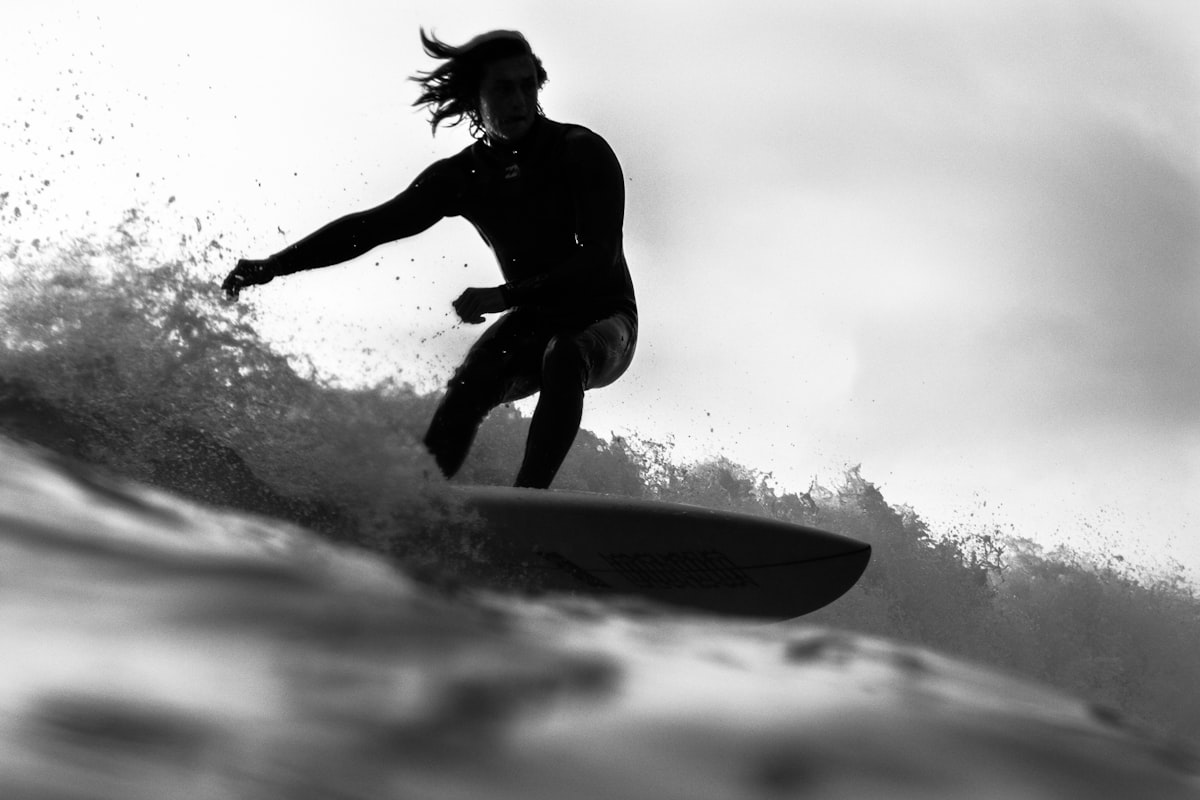
The knees are vulnerable in surfing because of the rotational forces involved in turning, the asymmetric stance, and the sudden loading during pop-ups and bottom turns. Your back knee is particularly at risk because it's typically internally rotated and flexed — a position that puts stress on the meniscus and the medial collateral ligament (MCL).
MCL Sprains
The MCL runs along the inside of your knee and resists forces that push the knee inward. During aggressive turns — especially powerful bottom turns where your back leg absorbs significant lateral force — the MCL can be stretched or torn. This is one of the most common acute knee injuries in intermediate and advanced surfers.
Working on injury prevention? Partner with Neptune on iPhone and Apple Watch.
Get the free appPrevention strategies:
- Strengthen your VMO (inner quad). The vastus medialis oblique stabilizes the knee against inward forces. Single-leg squats, step-downs, and terminal knee extensions specifically target this muscle.
- Build single-leg stability. Surfing is essentially a single-leg sport — your weight constantly shifts between your front and back foot. Single-leg deadlifts, Bulgarian split squats, and balance board work build the proprioception and strength that protect your knees during dynamic movements.
- Warm up your knees before surfing. A few minutes of bodyweight squats, leg swings, and light jogging before paddling out increases synovial fluid production in the joint, reducing friction and improving shock absorption.
Meniscus Tears
The menisci are C-shaped cartilage pads that cushion the knee joint. Twisting on a loaded, flexed knee — exactly what happens during aggressive turns — can tear the meniscus. This is especially common in surfers over 30, as the meniscus becomes less resilient with age.
Prevention strategies:
- Don't skip leg day. Strong quads, hamstrings, and glutes absorb forces that would otherwise be transmitted directly to the meniscus. Squats, lunges, and hamstring curls are foundational.
- Improve your hip rotation. When your hips are stiff, your knees compensate by rotating more than they're designed to. The same hip mobility work that protects your back also protects your knees.
Lacerations and Impact Injuries
Cuts, bruises, and impact injuries are the most common acute injuries in surfing. Your board is the most frequent culprit — fins are sharp, rails are hard, and a board driven by a wave carries serious force. The reef, rocks, and other surfers round out the list.
Fin Cuts
Surfboard fins are the leading cause of lacerations in surfing. They most commonly strike the surfer's own legs and feet during wipeouts, but can also injure other surfers in collisions.
Prevention strategies:
- Use a proper leash. A leash that's the right length for your board (roughly the same length as the board) keeps it close enough to control but gives you enough distance to avoid being hit during most wipeouts. Replace your leash regularly — they weaken with UV exposure and use.
- Cover your head when wiping out. After falling, keep one arm over your head and the other extended in front of your face as you surface. This protects your head and face from your returning board.
- Consider rubber-edged fins. If you're surfing in crowded lineups, some fin manufacturers offer fins with softer leading edges that reduce laceration severity.
Reef Injuries
Surfing over shallow reef introduces the risk of serious cuts, abrasions, and puncture wounds. Coral cuts in particular are notorious for slow healing and infection because fragments of coral can embed in the wound.
Prevention strategies:
- Wear reef booties. If you're surfing a reef break, neoprene booties protect your feet from the worst of it. Many surfers resist booties because of the feel change, but a serious reef cut can keep you out of the water for weeks.
- Know the bottom. Before surfing an unfamiliar reef break, talk to locals about the depth and hazards. Know where the shallow sections are and plan your wipeout strategy accordingly.
- Clean reef cuts immediately and thoroughly. If you do get cut on reef or coral, clean the wound with fresh water, remove any visible debris, and apply antiseptic. Reef cuts that get infected can become serious quickly — don't ignore them.

Overuse Injuries: The Slow Burn
Not all surfing injuries are dramatic. Many of the most frustrating injuries develop gradually through repetitive stress — you don't notice a problem until it's already limiting your surfing.
Surfer's Ear (Exostosis)
Surfer's ear is a bony growth in the ear canal caused by repeated exposure to cold water and wind. The bone grows slowly over years, gradually narrowing the ear canal. In advanced cases, it traps water and debris, leading to frequent ear infections and even hearing loss. Surgery is the only treatment once the growth is significant.
Prevention strategies:
- Wear earplugs. This is the single most effective prevention measure, and it's almost criminally underutilized. Custom-molded surf earplugs cost around $60-100 and let you hear while blocking wind and water. Off-the-shelf options like SurfEars work well too.
- Dry your ears after every session. Tilt your head and shake out water, then use a towel or a few drops of a drying solution (equal parts rubbing alcohol and white vinegar).
- The colder and windier your conditions, the more important ear protection becomes. Surfer's ear progresses fastest in surfers who regularly surf in water below 60°F with offshore winds.
Surfer's Myelopathy
This is a rare but serious condition where the blood supply to the spinal cord is temporarily compromised, usually from prolonged hyperextension of the spine during paddling. It most commonly affects beginner or infrequent surfers who spend long periods lying on the board with their back excessively arched. Symptoms include sudden weakness or paralysis in the legs after a long paddling session.
Prevention strategies:
- Build up your surf time gradually. Don't go from zero to three-hour sessions. If you're returning from a long break, limit your first sessions to 60-90 minutes and increase gradually.
- Maintain a moderate arch while paddling. You need some extension to see ahead, but excessive arching — where your ribs lift significantly off the board — is unnecessary and increases risk.
- Take breaks during long sessions. Sit up on your board between sets to relieve the sustained extension on your spine.
Building an Injury Prevention Routine
Knowing about individual injuries is useful, but what actually keeps you healthy is a consistent prevention routine. Here's a practical framework that addresses the most common risk factors:
Before Every Session
- Dynamic warm-up (5-10 minutes). Arm circles, leg swings, torso rotations, bodyweight squats, and light jogging. This increases blood flow, warms up your joints, and prepares your nervous system for the demands of surfing. Don't static stretch before surfing — save that for after.
- Assess your body. If something is sore or tight, acknowledge it. Modify your session accordingly — maybe skip the heavy bottom turns if your knee is talking to you, or cut the session short if your shoulder isn't feeling right.
During Your Session
- Listen to your body. Fatigue is the single biggest risk factor for acute injuries. When you're tired, your technique breaks down, your reaction time slows, and your muscles can't protect your joints as effectively. Getting out 15 minutes early is always better than spending six weeks out of the water.
- Stay hydrated. Dehydration accelerates fatigue and impairs coordination. Drink water before and after — and during, if you're doing a long session.
After Every Session
- Static stretching (5-10 minutes). Focus on the areas that work hardest: shoulders, chest, hip flexors, lower back, and hamstrings. Hold each stretch for 30-60 seconds.
- Cool down gradually. A short walk on the beach is ideal — it helps your body transition out of exercise mode and promotes blood flow for recovery.
Weekly Maintenance
- Strength training 2-3 times per week. Focus on shoulders (external rotation, scapular stability), core (anti-extension, anti-rotation), and legs (single-leg strength, hip stability). You don't need to spend hours in the gym — 30-45 minutes of targeted work makes a massive difference.
- Mobility work. Thoracic spine rotation, hip opening, and ankle mobility keep your joints moving through their full range of motion so your body doesn't develop compensatory patterns that lead to injury.
- Rest days. Your body repairs and adapts during rest, not during training. At least one full rest day per week — more if you're surfing heavy waves or logging long sessions.
When to See a Professional
Not every ache requires a doctor visit, but certain signs should prompt professional evaluation:
- Sharp pain during specific movements — this suggests a structural issue, not just muscle soreness
- Pain that worsens over several weeks despite rest and home treatment
- Numbness, tingling, or weakness in any extremity
- Joint swelling that doesn't resolve within a few days
- Any head injury — even if you feel fine, concussion symptoms can be delayed
A sports medicine physician or physical therapist who understands surfing biomechanics is ideal. They can identify the root cause of your injury — which is often a movement pattern or weakness rather than the injury site itself — and create a targeted rehab plan that gets you back in the water faster.
Stay in the Water Longer
Surfing is a lifelong pursuit, and the surfers who enjoy it the longest are the ones who take care of their bodies proactively — not just reactively. You don't need to become a gym rat or a flexibility guru. You just need consistent, targeted maintenance: warm up before sessions, strengthen the muscles that surfing neglects, maintain mobility in the joints that surfing tightens, and listen to your body when it tells you something is off.
The best session is always the next one. Take care of your body so you can keep paddling out for decades to come.
Read it. Then take it to the water.