Yoga for Surfers

Neptune
April 25, 2026
Why Yoga and Surfing Belong Together
The parking lot stretch is a halfhearted twist and a rolled shoulder.
A smart yoga practice builds the mobility, strength, and calm surfing actually uses.
Surfing is a sport of paradoxes. It demands explosive power and patient stillness. It rewards strength but punishes rigidity. You need shoulders that can paddle for hours, hips that can drop into a deep stance in a fraction of a second, a spine that rotates fluidly in three planes, and a nervous system that stays calm when you're tumbling underwater not knowing which way is up.
There is, conveniently, a several-thousand-year-old practice designed to develop almost every one of those qualities. Yoga is the single best cross-training tool for surfing — not because it's trendy, not because it looks good on Instagram, but because the physical and mental adaptations it produces map almost perfectly onto what the ocean asks of you.
This guide is not a generic yoga primer. It's a surf-specific practice built around the joints, movement patterns, and mental skills that determine how well — and how long — you surf.
What Yoga Actually Does for Your Surfing
Before we get into poses, it helps to understand the why. Generic flexibility is not the goal. Becoming a human pretzel doesn't help you surf better. What you want is functional mobility in the right places, paired with stability where it counts.
Hip Mobility for the Pop-Up and Bottom Turn
Your pop-up is a hip-driven movement. The faster and deeper you can drop into a low, athletic stance, the better your transitions will be on every wave. Most surfers — especially those of us who sit at desks — have hips that are locked into a narrow, anterior-tilted range. Tight hip flexors pull on your lumbar spine; weak glutes leave you unable to stabilize your back foot through a turn.
Yoga restores the rotational and end-range hip mobility that surfing demands. Poses like pigeon, low lunge, lizard, and frog open the front, sides, and inner thighs in ways no static stretch routine touches.
Thoracic Spine Rotation for Turns
Watch any high-level surfer's bottom turn or cutback in slow motion. The power doesn't come from arms or legs — it comes from a coiled rotation through the upper back. Your thoracic spine (the middle 12 vertebrae) is supposed to provide most of your trunk rotation. In most adults, it doesn't, because we spend our lives hunched forward and barely twisting at all.
When the thoracic spine can't rotate, your lower back tries to compensate. That's the recipe for the chronic lumbar pain almost every long-time surfer eventually develops.
A consistent yoga practice systematically frees up thoracic mobility through poses like revolved triangle, thread the needle, and seated twists. You'll feel the difference the next time you carve.
Shoulder Endurance and Health
Paddling is a shoulder-dominant movement repeated thousands of times per session. Without sufficient mobility and stability through the rotator cuff, the shoulder joint gets compressed and impinged with every stroke. The result, predictably: rotator cuff tears, biceps tendinopathy, and the slow erosion of paddle endurance.
Yoga loads the shoulders in unique ways — supporting body weight overhead, in plank, in down-dog, in wheel — that build the small stabilizing muscles standard gym work tends to miss.
Breath Control Under Stress
The single most underrated benefit of yoga for surfers is what happens to your nervous system. Pranayama — yogic breathing — trains you to consciously regulate your breath under physical stress. That's the exact skill you need when you're held down after a wipeout, paddling against a current, or trying to stay loose for a critical takeoff.
The surfers who can stay calm during a two-wave hold-down aren't necessarily the ones with the biggest lungs. They're the ones who have practiced staying composed when their body is screaming for oxygen. Yoga is one of the most direct ways to build that skill on dry land.
The Foundational Surf-Yoga Sequence
What follows is a 25-minute practice you can do three to four times a week. It targets the specific areas that limit surfers most and builds in difficulty as you get stronger. Do it on a yoga mat, on a beach towel, or barefoot on the sand. No props required.
Move slowly. Stay in each pose for the full duration. The goal is not to "complete" the practice — it's to spend time in positions your body needs.
Opening: Centering and Breath (3 minutes)
Sit cross-legged. Close your eyes. Place one hand on your chest and one on your belly.
Inhale through the nose for a slow count of four, expanding your belly first, then your chest. Hold for four. Exhale through the nose for six, drawing your belly toward your spine. Hold empty for two. Repeat for three minutes.
This is box breathing with a slightly extended exhale — the same pattern that activates your parasympathetic nervous system before a heavy session. You're not just relaxing. You're rehearsing a mental skill you'll use in the lineup.
Cat-Cow (1 minute)
On hands and knees. Inhale, drop your belly, lift your chest and tailbone (cow). Exhale, round your spine to the ceiling, tucking your chin and tailbone (cat). Move slowly with your breath.
This is the warm-up your spine needs after a day of sitting. It also begins waking up the thoracic mobility you'll use later.
Down Dog with Pedaling (2 minutes)
From hands and knees, tuck your toes and lift your hips up and back into downward-facing dog. Hands shoulder-width, feet hip-width, fingers spread wide.
Don't force your heels down. Instead, "pedal" your feet — alternately bending one knee and pressing the other heel toward the floor. Stay here for two minutes, breathing slowly.
Down dog opens your shoulders, hamstrings, and calves all at once. The pedaling adds movement to keep the calves and Achilles from locking up — both common chronic tight spots in surfers.
Low Lunge with Twist (90 seconds per side)
Step your right foot forward between your hands. Drop your back knee to the mat. Sink your hips forward, feeling the stretch through the front of your left hip flexor.
Lift your right hand to the sky and rotate your chest open to the right. Your gaze follows your hand. Hold for 90 seconds. This combines a hip flexor stretch with a thoracic rotation — two of the highest-leverage movements for surfers.
Switch sides.
Lizard Pose (90 seconds per side)
From low lunge, walk your right foot to the outer edge of your right hand. Lower onto your forearms if you can. If your back hip wants to lift, stay on your hands.
This is the deepest hip opener in the practice. You'll feel it through the inner thigh, the front of the back hip, and the outer hip of the front leg — all the surfaces that limit your stance depth on a board.
Working on hip mobility? Partner with Neptune on iPhone and Apple Watch.
Get the free appSwitch sides.
Pigeon Pose (2 minutes per side)
From down dog, bring your right knee forward toward your right wrist. Slide your right ankle toward your left wrist (the more parallel your shin is to the front of the mat, the deeper the stretch — but only go where your hip allows). Extend your back leg straight behind you.
If you feel pain in the knee, back off. If it's intense in the outer hip, stay there. Lower your chest toward the floor on an exhale and breathe.
Pigeon is the king of surf-yoga poses. The outer hip, the piriformis, and the deep glute fibers — all of which get overworked in surfing — need this stretch desperately. Two full minutes per side. Set a timer. Breathe through the discomfort.
Bridge Pose (1 minute, repeated 3x)
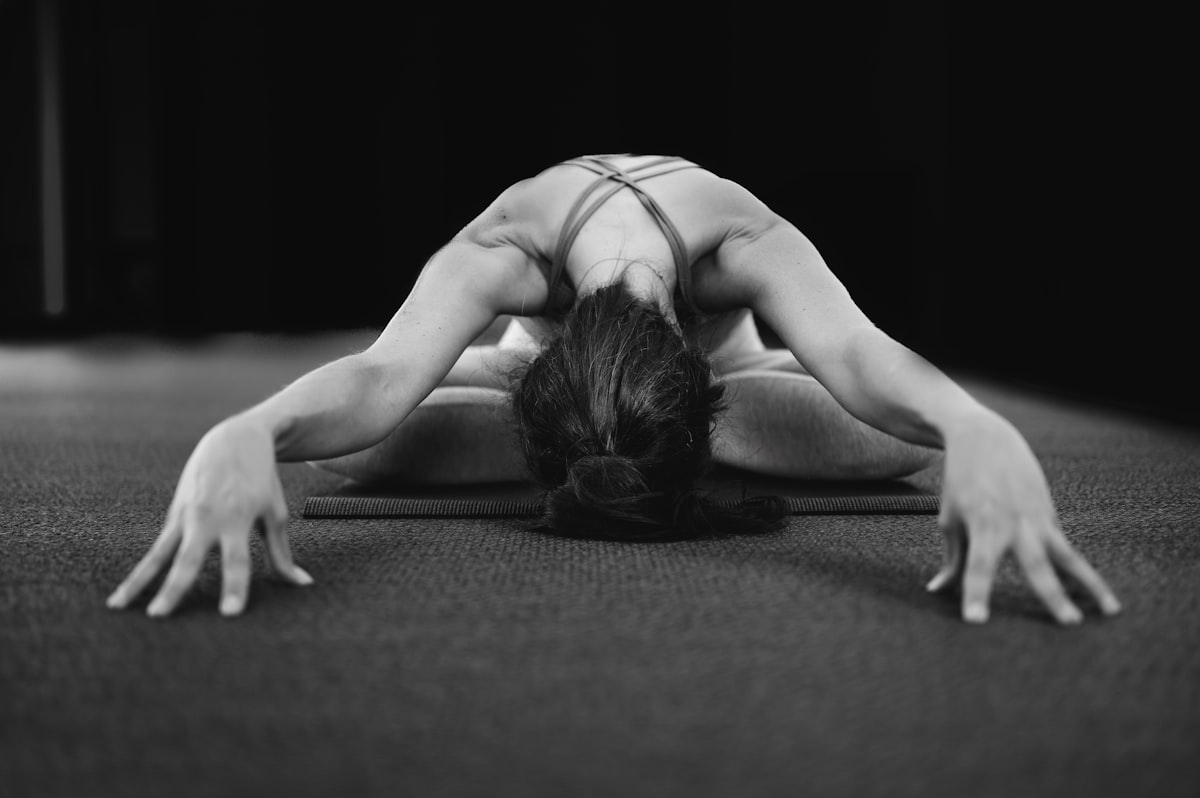
Lie on your back, knees bent, feet hip-width and parallel. Press your feet into the floor and lift your hips up. Squeeze your glutes.
Hold for one minute. Lower. Rest 20 seconds. Repeat three times.
Bridge actively strengthens the glutes and hamstrings — the muscles that drive the back-foot pressure during your turns. Surfers are notoriously glute-weak. This fixes that.
Supine Twist (90 seconds per side)
Lie on your back. Hug your right knee to your chest. Cross it over your body to the left. Extend your right arm out to the side and turn your head to the right.
Let gravity do the work. Don't force the knee down. Breathe into the stretch through the lower back and hip.
Switch sides.
Savasana (3 minutes)
Lie flat on your back, arms at your sides, palms up, feet falling open. Close your eyes. Breathe normally.
Don't skip this. This is not "lying around" — it's the part of the practice where your nervous system integrates the work you just did. It's also direct training for the calm-under-pressure skill that defines confident surfers.
Pranayama: Breathing Practices for Surfers
The breathing side of yoga deserves its own attention because it translates so directly to the water. Two practices in particular are worth weaving into your routine.
Nadi Shodhana (Alternate Nostril Breathing)
Sit upright. Use your right thumb to close your right nostril. Inhale slowly through the left nostril. Close the left nostril with your ring finger. Exhale through the right. Inhale through the right. Close, exhale through the left. That's one full cycle.
Do 10 cycles. This balances the nervous system in a way that's almost impossible to fake — try it before a session at a heavier break and notice how much steadier your mind feels in the lineup.
Box Breathing (Sama Vritti)
Inhale four, hold four, exhale four, hold four. Five minutes daily.
The same Navy SEALs and big-wave surfers swear by this. It's the same pattern from the opening of the practice above. Make it a daily habit and you'll find yourself reaching for it automatically when the swell jumps or you're caught inside.
CO2 Tolerance Walks
This is less traditional yoga and more applied breath training. Walk normally. Inhale fully through the nose. Exhale fully. Now hold your breath — completely empty — and continue walking. Count your steps until you absolutely need to inhale.
Recover with calm nasal breathing for 60 seconds. Repeat five times.
This builds CO2 tolerance, which is the actual physiological factor that determines how long you can comfortably hold your breath underwater. It's not lung capacity that fails you during a hold-down — it's the panic response that fires when CO2 builds up in your blood. Train that response, and your wipeouts feel dramatically less catastrophic.
Building a Weekly Practice
You don't need to do an hour of yoga every day to see massive benefits. Here's a realistic structure based on how much time you actually have.
Minimum Effective Dose (10 minutes, 3x per week)
Pick three poses: pigeon, low lunge with twist, and supine twist. Two minutes per side. Done.
This alone, done consistently for a month, will change how your body feels in the water. It addresses the three biggest restriction patterns in most surfers — outer hip, hip flexor, and lower back rotation.
Standard Practice (25 minutes, 3-4x per week)
The full sequence above. Pair it with a daily five-minute breathing practice.
This is the level where you'll start noticing measurable changes in your surfing — deeper bottom turns, longer paddle sessions, less back stiffness after long sessions, faster recovery between days in the water.
Advanced Integration (45-60 minutes, 4-5x per week)
Add a Vinyasa or Hatha class to the mix once or twice a week. The flow component builds shoulder endurance and upper-body stability in ways static holds don't. Look for instructors who emphasize alignment over showy postures — you don't need to do handstands. You need to move well.
Common Mistakes Surfers Make in Yoga
A few patterns derail surfers who try to take up yoga seriously. Watch for them.
Treating It Like Stretching
Yoga is not a stretching session. It's a movement and breath practice. If you're not breathing deliberately throughout the whole practice, you're missing most of the benefit. The poses are scaffolding. The breath is the work.
Forcing Range of Motion
The fastest way to injure yourself in yoga is to push aggressively into a stretch with breath-holding and tight muscles. Your nervous system reads that as a threat and tightens further. Move gradually. Breathe slowly. The depth comes over weeks, not minutes.
Skipping the Hard Parts
Most surfers will happily hang out in down dog and skip pigeon because pigeon is uncomfortable. Pigeon is uncomfortable because you need it. The poses you don't want to do are the ones that pay off most. Set a timer and stay in them.
Ignoring the Mental Side
If you treat savasana and pranayama as optional, you're throwing away half the value of the practice. The physical poses keep your body capable. The breath and stillness work is what you'll actually use during a heavy hold-down or when you're trying to commit to a wave that scares you.

When and How to Practice
A few practical notes on integrating yoga around your surf schedule.
Pre-surf: Do a short, dynamic version. Cat-cow, down dog, low lunges, a few sun salutations. Five to ten minutes. Avoid long static holds — they can temporarily reduce muscle power output, which you don't want before paddling.
Post-surf: This is the ideal time for the long static work — pigeon, lizard, supine twist. Your muscles are warm, your nervous system is open, and you'll get more range than at any other time of day.
Rest days: A full 25-minute practice is perfect on a flat day or a day off. It accelerates recovery and keeps your tissues moving.
Travel: A travel mat fits in any board bag. After a long flight, 15 minutes of hip openers and twists makes the difference between paddling out fresh and paddling out wrecked.
What to Expect Over Time
If you commit to a real practice — three sessions a week, six to eight weeks — here's what you'll likely notice in the water:
- Your pop-up gets faster and more stable, almost without trying
- Your back feels less sore after long sessions
- Bottom turns and cutbacks have more rotation and drive
- You can paddle longer before your shoulders give out
- Hold-downs feel less panicked because your CO2 tolerance has improved
- You're calmer in the lineup — both mentally and physically
The surfers who keep surfing well into their 60s and 70s aren't the ones who out-trained everyone in their 30s. They're the ones who treated mobility, breath, and recovery as core skills rather than afterthoughts. Yoga is one of the most efficient tools for that kind of long-game practice.
Roll out a mat. Spend 25 minutes. Then go surf better.
Read it. Then take it to the water.