Surfboard Volume: How to Find Your Number

Neptune
April 30, 2026
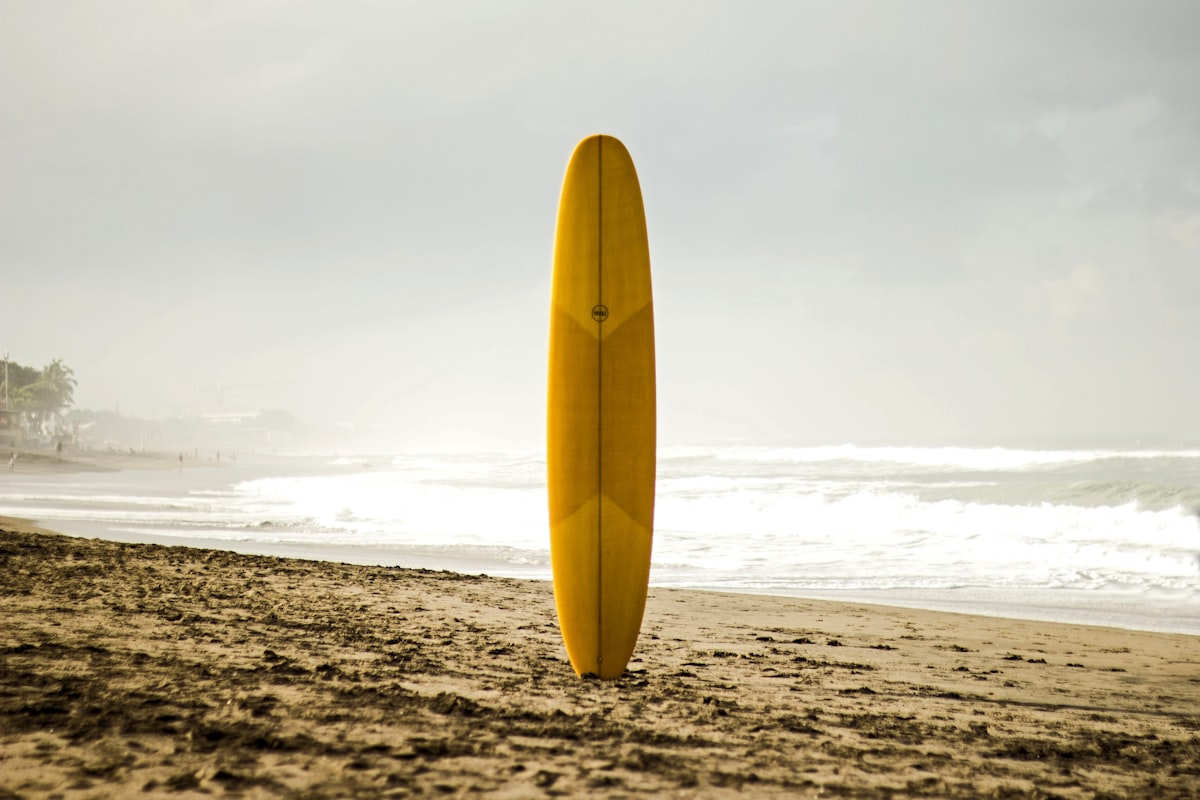
The Most Misunderstood Number on Your Surfboard
The number with an L on the tail is liters — the board's volume.
It is the most important spec on a modern board, and the one most surfers get wrong.
For decades, surfers chose boards based on length. "I ride a 6'2"." "I'm a 9'0" guy." It was an imperfect shorthand because two boards of the same length can have wildly different float, paddle power, and wave-catching ability depending on their thickness, width, and outline. Length tells you almost nothing on its own.
Volume changed that. By measuring the total cubic displacement of foam, shapers gave us a single number that captures the board's float — and float is what dictates how easily you paddle, catch waves, and stay on top of the water during lulls. Get your volume right, and surfing gets dramatically more fun. Get it wrong, and you'll spend every session fighting your equipment instead of riding waves.
This guide will walk you through how volume works, how to calculate the right number for your body and ability, and the specific situations where you should deliberately go higher or lower than the formula suggests.
What Volume Actually Measures
Volume is a measurement of the three-dimensional space your surfboard occupies, expressed in liters. A board with 30 liters of volume displaces 30 liters of water — which, by Archimedes' principle, means it can support roughly 30 kilograms (66 pounds) of weight at the waterline before it starts to sink.
That's a useful frame, but it's not how volume actually plays out in the water. A surfboard never just floats statically — you're paddling, sitting, popping up, and turning. Volume affects all of these:
- Paddle power: More volume sits higher on the water, reducing drag. You paddle faster with less effort.
- Wave catching: A more buoyant board planes earlier, so you can catch waves before they get steep.
- Pop-up stability: Higher volume gives you a wider, more stable platform for those critical first seconds standing up.
- Lulls and waiting: More float means less effort to stay in position between sets.
- Maneuverability: Less volume sinks lower, engages the rails sooner, and turns more responsively.
This is the fundamental tradeoff: more volume makes wave-catching and paddling easier, less volume makes turning and rail work easier. Your job is to find the sweet spot for where you are right now — not where you want to be in two years.
The Standard Volume Formula
The most widely-cited starting point comes from a formula popularized by shaper Matt Biolos of Lost Surfboards. It uses your body weight in kilograms multiplied by a coefficient based on your skill level:
Volume (liters) = Body Weight (kg) × Coefficient
The coefficients are roughly:
- Beginner: 0.55 to 0.70
- Intermediate: 0.40 to 0.45
- Advanced: 0.35 to 0.40
- Pro / Expert: 0.30 to 0.35
So a 75 kg (165 lb) intermediate surfer would land around: 75 × 0.42 = 31.5 liters.
A 90 kg (198 lb) beginner would land around: 90 × 0.65 = 58.5 liters.
A 70 kg (154 lb) advanced surfer would land around: 70 × 0.37 = 25.9 liters.
This formula is a starting point, not gospel. It gives you a number to anchor your decision, but you'll adjust from there based on the conditions you surf, the kind of board you ride, and several other factors we'll get to.
How to Honestly Assess Your Skill Level
The biggest mistake people make with this formula is overestimating their skill level. Be honest. If you'd describe yourself as intermediate but you ask someone else, they might call you a beginner. Use these markers:
- Beginner: Still learning to pop up consistently, surfing mostly whitewater or just-broken green waves, riding straight to shore.
- Intermediate: Catching unbroken waves, angling down the line, doing basic turns, comfortable in waves up to head-high. Still wipes out frequently when trying anything beyond basic riding.
- Advanced: Linking turns smoothly, surfing waves overhead, carving with intention, can handle most conditions you encounter. Your board limits you more than your ability does.
- Pro / Expert: Sponsored, contest-level, or someone who could sponsor a small contest. If you're reading this, this isn't you. (And that's fine — most people don't need a 0.30 coefficient board.)
When in doubt, round up your coefficient. A board that's slightly too floaty is annoying. A board that's significantly too small is unrideable.
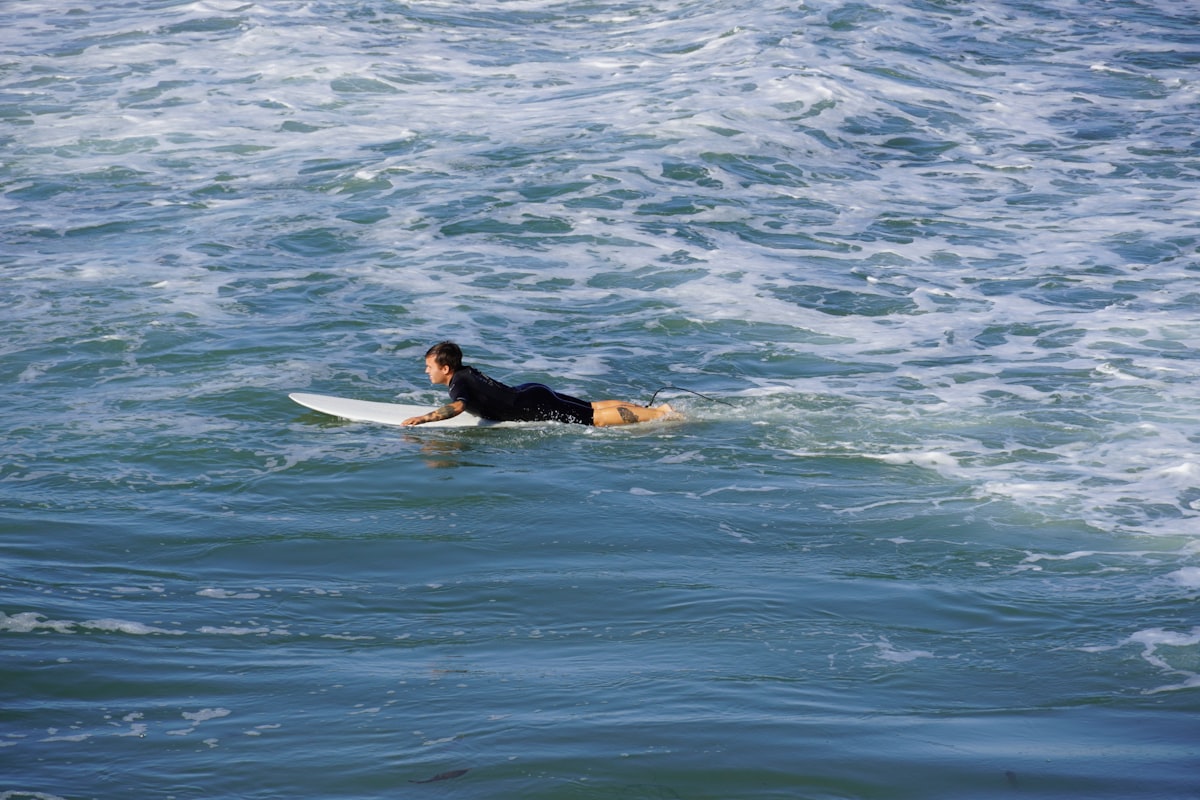
Adjusting for the Waves You Actually Surf
The formula above assumes you're surfing chest-to-head-high waves with reasonable shape — clean conditions where the wave is doing some of the work for you. Real surfing isn't always like that. You need to honestly assess what you actually paddle out into most days.
Small, Weak Waves
If your home break is mostly knee-to-chest-high mush, add 2 to 5 liters above your calculated number. Small waves don't have enough power to push a low-volume board, and you'll spend most of your session struggling to catch anything. This is why fish, mid-lengths, and groveler shapes exist — they exist because most surfing happens in unspectacular waves and the right tool matters.
Powerful, Hollow Waves
If you regularly surf overhead reef breaks, point breaks, or anywhere with real power, you can subtract 1 to 3 liters. Powerful waves push you into position; you don't need extra float to catch them. And once you're up and riding, less volume means more control on a steep, fast face.
Cold Water
Working on your surfing? Partner with Neptune on iPhone and Apple Watch.
Get the free appThis one surprises people. If you're surfing in a 4/3 wetsuit, booties, gloves, and sometimes a hood, all that neoprene adds up to 2-4 kilograms of extra weight when wet. That weight needs to be supported. Add 1-2 liters if you're regularly surfing in full winter rubber.
Older Surfers and Recovering from Injury
Recovery, joint health, and conditioning all factor in. If you're over 50, returning from injury, or just don't have the paddling fitness you used to, add 2-4 liters. There's no medal for grinding through sessions on a board that's too small. More float means more waves caught, more time on your feet, and less wear on your body.
Volume by Board Type
Here's where it gets nuanced. Volume isn't distributed evenly across all surfboards. Where the foam sits matters as much as how much there is.
Shortboards (Performance Boards)
The pure performance shortboard distributes volume across the middle of the board with thinner rails and a tapered nose and tail. The volume number you calculate from the formula above applies most directly here. A 31L shortboard for an intermediate is a reasonable, rideable performance board.
These boards are designed to be ridden close to your weight threshold. They're meant to sink slightly, engage rails immediately, and respond to body movement. They reward fitness and punish over-eager wave selection.
Fish and Groveler Shapes
Fish and grovelers concentrate more volume forward, with wider noses, flatter rockers, and fuller rails. A 32L fish paddles and catches waves like a 35L shortboard would — the extra width and flatness up front add planing speed without much penalty in turn radius.
For most everyday conditions (waist to head-high), a fish or groveler with 2-4 liters above your shortboard number is the sweet spot. This is why so many people who switch to a fish describe it as a revelation: they're catching twice as many waves and finally surfing instead of paddling.
Mid-Lengths
Mid-lengths (6'8" to 7'8") sit in a wonderful in-between zone. They typically run 8-15 liters above your shortboard number but use that extra foam differently — through length and outline rather than thickness. A mid-length is forgiving, fast in trim, and far more maneuverable than a longboard. For surfers who want to catch a lot of waves but still feel performance under their feet, these are hard to beat.
Longboards
Longboards play by different rules. The volume calculator becomes nearly irrelevant — a 9'0" longboard might have 65-75 liters regardless of who's riding it, because the length and width drive the volume math. What matters more for longboards is your weight relative to the board's overall outline and how much foam is up front for nose-riding.
A general rule: pick a longboard that's at least 3 feet longer than your height for a traditional log, or 1-2 feet longer than your height for a high-performance longboard.

The Volume Spectrum: Three Surfers, Three Boards
Let's make this concrete with three example surfers.
Sarah, 60 kg, intermediate, surfs mostly chest-high beach breaks in California.
Calculator math: 60 × 0.42 = 25.2 liters for a shortboard. But her conditions are average rather than powerful, so she adds 2 liters and lands at 27 liters. For a daily-driver fish, she'd add 3-4 more and look at boards in the 30-32 liter range. She picks a 5'8" fish at 31 liters and catches more waves in a single session than she did all month on her old 5'10" performance shortboard.
Marcus, 85 kg, advanced, surfs Hawaii's North Shore in winter.
Calculator math: 85 × 0.37 = 31.5 liters. But Marcus is surfing serious waves with real power, so he subtracts 2 liters and lands at 29.5 liters. For Pipeline-caliber surf, he might go even lower — around 28L on a step-up shortboard with extra length and rocker, designed for steep, fast drops rather than float.
David, 95 kg, returning to surfing after a 5-year break, surfs San Diego beach breaks.
If we're being honest, David is functionally a beginner-intermediate hybrid. Calculator math at 0.55 (high-end beginner): 95 × 0.55 = 52.3 liters. He could go even higher given his fitness level and San Diego's often-mushy conditions. He picks up a 7'2" mid-length at 56 liters. Within three sessions, he's catching waves consistently and his confidence is back. In six months, he'll size down — but starting on the wrong board could've cost him a year of rebuilding skills.
Common Volume Mistakes (and How to Fix Them)
Mistake 1: Riding the Pro Model
Your favorite pro is 70 kg, freakishly fit, and surfing pumping conditions every day. Their 26L shortboard is not a template for you. Pro boards are extreme tools designed for extreme surfing. Even most pros' "everyday" boards are higher-volume than what they ride in contests.
If you weigh more than the pro and surf less powerful waves than they do, you need significantly more volume than their signature dimensions. Volume scales with bodyweight; pros surf scaled-down versions of their bigger sponsors' rosters.
Mistake 2: Underestimating How Much Volume You Lose with Length
When you size down from a 6'4" to a 6'0", you don't lose just four inches — you lose substantial liters. Most shapers don't proportionally adjust the rest of the board to compensate. Always check the volume number when sizing down a length.
Mistake 3: Buying for Aspirations, Not Reality
The classic mistake: an intermediate buys an advanced surfer's board because they want to surf at that level "soon." They then paddle worse, catch fewer waves, surf less, and progress slower than if they'd bought the right board.
You don't grow into a surfboard like you grow into a pair of shoes. You either ride it well or you don't. Buy for the surfer you are today.
Mistake 4: Ignoring Volume Distribution
Two boards with identical volume numbers can feel completely different in the water. A 30L shortboard with thin rails and a tapered nose feels nothing like a 30L fish with full forward foam. Always look at thickness, width, and outline alongside volume — the number tells you how much float you have, not how that float is delivered.
Mistake 5: Not Adjusting Seasonally
Many surfers ride the same board year-round, even though their body, fitness level, and home conditions shift dramatically. If you take a few months off in winter and come back stiff and out of shape in spring, your spring board should probably have a few extra liters until you build paddling fitness back. Listen to your sessions, not your ego.
Building a Volume-Aware Quiver
Once you understand volume, building a quiver becomes intuitive. Most everyday surfers benefit from a small spread — typically two to three boards — that cover the conditions they actually surf:
- A daily driver at your "normal" volume (use the formula, adjust for typical conditions). This board catches 70% of your sessions.
- A groveler roughly 4-6 liters above your daily driver, for the days when conditions are weaker than usual. This board saves bad sessions.
- A step-up roughly 2-4 liters below your daily driver, for the rare days when conditions are bigger and faster. This board lets you surf with control when others are over-bored.
If you're newer to surfing, start with just the daily driver — and bias it slightly toward groveler dimensions. You'll surf better waves more often than you'll surf overhead Pipeline.
How to Use Volume When Buying Your Next Board
Walking into a shop or browsing online, here's the practical workflow:
- Calculate your baseline number using the formula above.
- Adjust for your conditions (wave size and power), wetsuit weight, and body factors.
- Adjust for board type (shortboard vs fish vs mid-length vs longboard).
- Compare against your current best board. If you have a board you love riding, look up its volume on the manufacturer's website. That number is your benchmark.
- Demo before committing. Many shops and brands offer demo programs. The number on a board is a starting point; how the board actually feels under your feet is the answer.
When in doubt, go up rather than down. An extra liter or two is rarely the reason a board doesn't work. Two liters too few, on the other hand, can make a board feel completely dead under you.
The Bigger Picture
The reason volume matters so much isn't just gear nerdery. It's because the right board changes your entire relationship with surfing.
When your volume is right, you paddle into waves easily. You catch more of them. You spend more time standing up, more time turning, more time surfing. Each session generates more reps, more feedback, more progression. The skill curve compounds.
When your volume is wrong, every session is harder than it needs to be. You miss waves your friends catch. You arrive at the lineup gassed. You wipe out before the wave has even given you a chance to surf it. Your progression flatlines, not because you lack ability but because your equipment is fighting you.
If you've been struggling to improve and you've never thought hard about your board's volume, this is the place to start. Run the math. Compare it to what you're actually riding. The gap might explain more than you'd expect.
Want to refine your board choice further based on your own conditions and tendencies? Neptune analyzes your sessions and conditions over time and can help you spot patterns — like whether you're consistently missing waves on your current board or struggling more on certain days. The right board is the one that lets you surf the version of yourself you actually are. The data tells you which one that is.
Read it. Then take it to the water.